All About 31: How to Play Mus

#Reflections
12.05.2024 Reading time: 6 minutes
BizkaiaTech editorial team
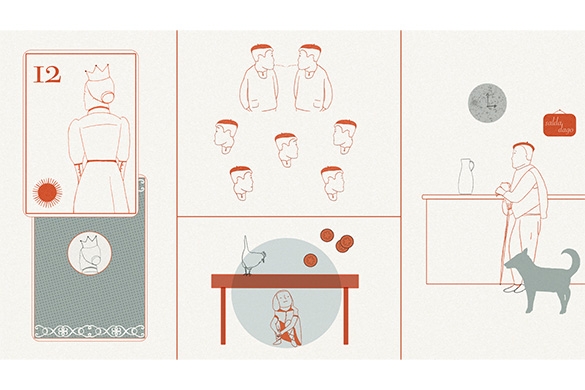
Ilustration: Leire Llano
Shall we play Mus? What? You don’t know how? Well, we’ll have to fix that, won’t we?
Later, we’ll share an article explaining the probabilities of winning a game of Mus, but first, you need to learn how to play, right? Don’t worry; it’s not as hard as it seems.*
*We’ll explain how to play Mus with eight Kings. If you want to play with four, only the card values will change.
FAMILY GATHERING
To play a game of Mus you need four people, it’s always played in pairs. Once you have three other players, it’s time to deal the cards. Be careful, though: the person dealing must have the deck cut by the person to their left, to ensure they haven’t stacked the deck to keep the Kings (the best cards, remember). After the deck is cut, deal four cards to each player.
Once the cards are dealt, each player looks at their hand. If you have a good hand (we’ll explain that shortly), you can start playing. Through gestures, you can discreetly signal your partner that you have a winning hand (but be careful, you could get caught!). If you don’t like your cards, you can say mus, indicating you want to redraw. However, for a new draw, everyone at the table must agree to say mus. If even one player wants to start, the game begins, and everyone must play with their current hand.
WHAT YOU WANT IN HAND
Kings, Kings, and more Kings! That’s what you want for a good hand. Here’s the card hierarchy: Kings are the highest, but since there are only four in the deck, the four cards marked "3" also count as Kings. After Kings, the next best cards are Knights (Caballos), then Jacks (Sotas), and so on. Cards valued "2" are worth the same as "1" and they have the lowest value (this equalization ensures there are eight of each).
WHAT GAME ARE WE PLAYING?
Mus is divided into four mini-games: grande (high), pequeña (low), pares (pairs), and juego (game), always in that order. Let’s start with grande:
The player to the dealers right begins. When someone “cuts” the game, we start playing grande. Here, the goal is to have the highest-ranking cards, especially Kings. One King beats four Knights or any hand without Kings, as cards are valued individually, not as sets. The best hand for this game is four Kings, followed by three Kings and a Knight, three Kings and a Jack, and so on. Got it?
After grande, we move on to pequeña, the opposite game. Here, the goal is to have the lowest cards, with the best hand being four ones. After that, it’s three ones and a four (remember, twos count as ones, and threes as Kings), three ones and a five, and so on.
In these first two games, all four players participate. But for the next two, things change. The third game, pares, is for players holding matching cards. If you don’t have pairs, you’re out; simple as that. There are three types of pairs: you can have one pair (two matching cards), which is the weakest pair, you can have medias (three matching cards, which are quite good and then there’s the duples (two pairs of matching cards), which is the best hand for this round. The player with the strongest pairs wins. For example, two Kings are beaten by a media of fours (three cards of 4), even though fours are lower in value.
Finally, we reach juego (game). Like the previous round, only players holding a “game” can participate. But what qualifies as a game? Here, you sum the values of your cards. All face cards (and threes, which are Kings) are worth 10 points. Cards from 4 to 7 retain their face value, and ones and twos are worth 1 point. The goal is to have 31 points. Examples include: three Kings and a one; Jack, Knight, King, and a one; or two Jacks, a seven, and a four. If no one has 31, the best game is 32, followed by 40, then descending to the worst game, 33. If no one has a game, the round is decided by punto, where the goal is to get as close to 30 as possible.
KEEPING SCORE
Now we technically know how to start our first game of this fun game, but what’s the goal? How do we know if we win or lose? How do we keep score? Go to the kitchen and grab a handful of chickpeas, we’ll explain it quickly.
A game of Mus is usually played to 40 points (tantos). But don’t worry, you won’t need 80 chickpeas to keep track of everything. When you “lift” a point, it’s collected by one of the two players in the team. Once that person has 5 points, they return them to the center of the table, and the other player gets an amarraco, which is worth five points. Upon reaching 35 points (seven amarracos), all the points are put back in the center, as a way to warn the other team that you’re just 5 points away from winning the game.
But, when should you lift a point? Mus is a betting game where you wager on your and your partner’s cards to win. You can bet because you’ve got a good hand or just to confuse your opponents. You can bet whatever you want: an envido, which is worth two points (you never bet just one point, and we’ll explain why later), three, four, or even the entire game, 40 points, which is called an ordago.
If we’re starting the game and someone bets on the grande, we have three options. The first would be to decline; do we have a hand without any Kings? Well, in that case we won’t want to participate, so we pass, so the person who placed the envido would lift one point since they made the bet and no one followed. The second would be to accept the bet; we have a pair of Kings, so it’s worth it, we’re in. Those two tantos we played will be counted at the end, once everyone reveals their cards. Lastly, there’s the option to add more tantos to the bet; we have three Kings and a Knight—it’s in the bag. Since we have an amazing hand, we’ll raise the bet by five more tantos. If the person who placed the envido is confident they can win, they’ll accept, and these points (seven total) will be counted at the end of the round. However, if they’re not convinced and say they won’t accept, our team will take the initial bet, which in this case was two tantos.
If it’s our turn to start the game, but we don’t have a good hand to bet anything, we can pass and let the others begin. If everyone passes, when the cards are revealed at the end, we’ll see who won the round, and they’ll take one point.
PRACTICE MAKES PERFECT
Yes, it’s true that all of this sounds quite complicated to understand and get started, but once you get the hang of it, we know it’ll become your favorite way to spend time with your friends or family. Otherwise, you always have the option of playing Mus apps on your phone… you’ve got to start somewhere!
Take our advice and check it out
Slide to show more