2084 A World Out There

#Reflections
04.17.2023 Reading time: 3 minutes
BizkaiaTech editorial team
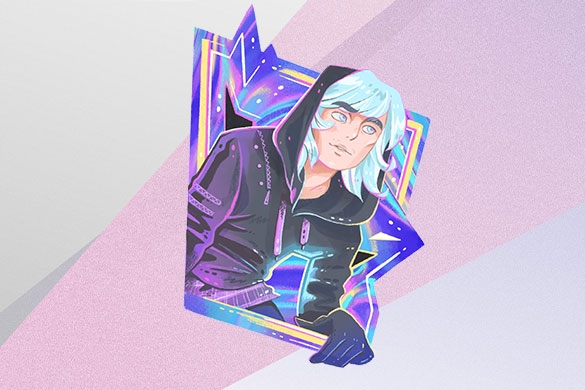
Illustration: Elena Urquijo
OCTOBER, 2032: the overpopulation of cities has pushed society to its limits. Prices, inflation, a lack of economic stability, and pollution are the perfect breeding ground for riots. The prelude to a revolution.
- “Another protest?” asked the Minister for Climate Restoration.
- “Yes, another protest, Alaia.”
- “We have to do something… we can’t keep turning a blind eye. This angry mob of environmentalists is going to eat us up. And the worst thing is that they’re right.”
- “Remember that we continue to live on citizen mobility data".
- “Yeah, but the situation is untenable. Cities are going to collapse from the amount of people on the streets, and we can hardly breathe without our canned oxygen. Last night I had a revelation… we can push the idea of a happy life in the metaverse. We’ll encourage the population to move there and travel to different cities. The people in the neighborhood and travellers won’t be a problem… but we’ll break the space-time barrier. Do you want to go to the future? We’ll send you to Seoul. Are you a nostalgic person? You can dance tango in Buenos Aires. Do you want to discover other eras? You’ll be able to experience the 6th-century BC and stroll through the Hanging Gardens of Babylon.”
- "It’s not a bad idea. We’ll reduce tourism and, eventually, get people to move there and let the planet breathe. A life without cars, without commuting, and without pollution.”
January, 2084: the population is increasingly polarized. There’s a clear division between those who have decided to face reality and not escape (like Idoia) and the Hikikomoris, who prefer to live in an alternate dimension. This is the case with Idoia’s son, Markel, absorbed in a sort of digital anesthesia in which life is designed pixel by pixel.
- “In your room again, Markel? I’ve prepared a warm cup of soup for you, just the way you like it. Why don’t you eat something and go out into the mountains to get some fresh air?”
- “I’m already in the mountains, mom, I’ve gone to spend the weekend with my friends.”
- “Come on, that’s not the mountains! Go out to get something more than just the feeling of air… you still need oxygen to breathe, even in your ‘world.’”
- …(Silence)…
- “You’re gonna go crazy… you don’t even know who’s behind those lenses”
Behind his new Virtual Reality contact lenses, Markel could be wherever he wanted to be at any time. He felt like a time traveler. Old-fashioned physical barriers were no longer a problem. He also didn’t have to deal with his neighbors, fuddy-duddies that were still wasting their precious time catching worthless trains and planes.- Who catches planes anymore? The train is still usable if you want to get to Álava, but even Teruel has a replica in the metaverse.
Reality, another thing from the past. Is this not real? Can’t you feel the breeze and smell the freshly cut grass? What you perceive as reality is nothing more than nerve stimuli… aren’t you feeling the same thing? This is highly developed, we’re no longer in 2022.
It’s 8:30 a.m. on any given Monday. Markel, like every day, jumps out of bed and, stretching, puts on his VR lenses to enter into his world. He doesn’t have to run after the city bus. He goes directly to class. He doesn’t even have to get dressed, as his avatar is always impeccable.
He used to be an introvert, and suffered from social anxiety, but since he moved to the metaverse he’s the first to have a drink after class at the MetaBar, a tavern that’s been around forever, founded back in 2053. He no longer feels like an outsider. Now he goes out to parties with his friends, plays Basque meta-pelota, and has even become fond of cooking.
Idoia no longer talks about anything else with her psychologist. Paradoxically, her world revolves around her son’s virtual world.
- “How long has it been since you last worried about this isolation?”
- “Not long at all, I worry more and more as time goes by. I know that these are things that young people do, but I just can’t understand why he doesn’t want to go out. He says he doesn’t need to, but it seems insane to me.”
- “Yes, this is another silent pandemic masquerading as normalcy. Fewer and fewer of us are in the ‘real world’ without having set up a perfect ‘parallel’ life.”
- “He’s a modern hermit. I told him to come and see you… that the therapy will do him good, and that this way he won’t have so much stress or anxiety when he goes outside, or, well…to the living room.”
- “And? Any response?”
- “Nothing. He doesn’t want to come out of that cave.”
- “Did you tell him about the alternative therapies? The robot assistant or the ‘Big Brother’ thing?”
- “No… he’s very evasive.”
Markel, more and more submerged in his universe, and totally oblivious to any traces of life outside his room, continued to go about his usual routine.
His life went by, between classes and meeting up with his friends. He was going to a normal university, a very well-done replica. A building with wide corridors and classrooms for 300 students, divided into sub-classrooms to attend class and correct group work. The faculty had their teaching assistants, exact digital twins capable of making the same decisions, answering questions, and grading student work just like the original person.
Markel and his friends had tried, with little success, to skip class. They sometimes sent their digital twins to class, but their budgets, as students, were so meager that what they managed to replicate wasn’t nearly as intelligent or developed in terms of language as the original people, so they always got caught, and were near failing.
Idoia no longer knew whether Markel had a psychological problem or this was just a way of life for young (and not-so-young) people. At first she thought it would just be a phase, that all the money he was asking for to buy virtual clothes, virtual excursions, virtual glasses and contact lenses was just another part of the game. In fact, she didn’t see it as such a bad thing because her son finally had a group of friends, and he was practicing Japanese while he was at it.
There are always things that the previous generation doesn’t understand about the new one; you know, that’s young people for you.” Markel’s grandmother didn’t understand why, when she was younger, Idoia and her teenage friends had spent hours playing with those white headsets designing their stick figures – too “old school” for today (there are terms that never go out of style, no matter how many years go by).

– At first, we didn’t realize how far things could go. It seemed like a great alternative.
Take our advice and check it out
Slide to show more