Will the Machine Govern Us?
#Soul tech
06.12.2025 Reading time: 8 minutes
Ekai Txapartegi
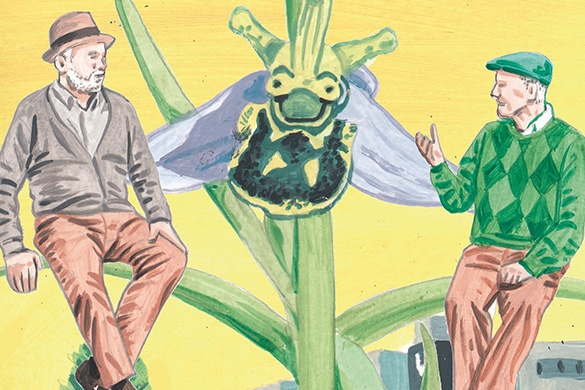
Illustration: Pablo Gallo
Some sticks with little red flags have appeared in the fields of the university. They are the resistance, life resisting against the machine. If you think about it, it’s another lost battle. Seen from an office, it’s just two retirees being a nuisance. A snapshot of the moment, if we reflect from a philosophical perspective.
From the classroom windows, you can see the university fields. When the lawnmower passes by, four or five times a year, making a loud "parrapapapapa" noise, an act of aggression occurs in the fields that cannot be perceived from up there. The machine cuts the delicate leaf rosettes of the bee orchid.
After several attacks over the years, the bee orchid has built an astonishing shield: two retirees. They are ecologists, and they mark the plants (ophrys apifera) with long sticks so they won’t be cut down.
The bee orchid is a wild orchid, a rare remnant of the surrounding flora that blooms now, from April to July. If left to grow, it disguises itself as a bee to attract real bees and thus pollinate itself. The relationship between the plant and the bee is highly sophisticated, of great interest from a biological perspective. A plant and a bee, nature deceiving nature, nature putting nature to work. This wisdom, millions of years old, is rooted in the university fields, but the subcontracted gardening company cuts and punishes the bee orchids. Of course, the gardeners have nothing against these plants. Since they must keep the fields tidy and the budget is tight, they do what is cheaper and quicker, exactly as society dictates.
The two retirees plant long sticks in the field. They are visible to everyone, marked with red ribbons. Even so, when I asked around, few people said they had noticed them, because we don’t see what we don’t understand. The people that walk around the University still don’t realize that these sticks are there to hinder the machine. Some call it a “fight.” To me, it feels more like poetry, because of the metaphorical and evocative power of pointing out the flowers with sticks to protect them from machines.
BODIES IN THE GEARS
In this sense, I especially remember one painful experience I had at the University of Berkeley in California: the moment when the iconic “anti-machine” café lost its way. Student activist Mario Savio, in his memorable speech on December 2, 1964, surrounded by university students, shouted from the plaza in front of the café:
"There is a time when the operation of the machine becomes so odious, makes you so sick at heart, that you can’t take part! You can’t even passively take part! And you’ve got to put your bodies upon the gears and upon the wheels, upon the levers, upon all the apparatus, and you’ve got to make it stop!"
Sixty years later, right there, a poorly-paid, unaware student-worker served me machine-made coffee in a plastic cup. It made me incredibly angry. Those sacred words deserve better. How could they allow a coffee machine to take over that sacred place? I can't think of a more effective way to trample the anti-machine movement than putting it at the service of a coffee machine.
In that university field, Savio represented himself as a bee orchid, subjected to the machine. He gave his speech a Luddite tone: we are people, we are against the machines! Even so, if we interpret him correctly, his criticism wasn’t against "technology" itself but against authoritarian capitalism. Metaphorically, he called authoritarian capitalism “the machine.” The students of the 1960s mobilized against autocracy, against the transformation of the university into a business, and against bureaucratization, commodification, and the violation of rights. The machine was the authoritarian logic that determined everything.
Sixty years have passed since then, and the machine still mows the grass cheaply and quickly to keep our fields tidy. Sixty years have passed, and in all this time, authoritarian capitalism has evolved into technological neoliberalism, driven by the need to do everything cheaper and faster.
TECHNOLOGICAL REPUBLIC
Alex Karp, owner of the tech company Palantir and an icon of technological neoliberalism, believes in technological determinism: Technology moves forward and drags people behind it. They use something like a motto: technology doesn’t kill; not adapting to technology kills. This is the new technocratic movement: the "tech bros," almost all men, billionaires, and even more radical than the technocrats of the 20th century: adapt (to technology) or die.
The evolution of technological development has changed how we understand technocracy. Nowadays, the 19th and 20th-century technocracy criticized by Weber and Habermas seems almost quaint: turning political decisions into 'technical' ones, the state administration making all important decisions without leaving real political options to the citizens. Politics becomes a show, and democracy a mere legitimizing mechanism. Today, that old bureaucratic technocracy would almost be comforting.
These new liberal technocrats have arrived after that ‘classic’ technocratization of liberal democracies. They are scarier; they want revenge. Ideologically, they are libertarians, embracing "solutionism" and hard power, believing that technology can solve even the toughest problems. Once they got the keys to the White House, they immediately began replacing government agency staff with software. Elon Musk’s "Department of Government Efficiency" (DOGE) is an example. From the traditional Government-Company technocratic model, we have moved to the Government Machine model, where all government decisions are automated through artificial intelligence and the streamlining of the most advanced software. Machines will decide what to do in every field because they know more than people, because they think better than people. It’s the most efficient way.
To understand this kind of extreme technocracy, Alex Karp’s book Technological Republic is very enlightening. Karp accuses Silicon Valley of using its privileged location to develop frivolous devices and apps, like Zynga games or Groupon coupons, weakening Western states and society at large. He even says empathy has weakened the West, with a brutal honesty. He calls for facing this weakening trend by combining technology with hard power: “Our technology is for protecting countries and killing people,” he stated recently in an interview. The gigantic machines they design dream of governing society in the name of maximum efficiency, the only way to compete with China's machinery and maintain Western supremacy.
BODIES IN THE GEARS OR GEARS IN THE BODY
Mario Savio or Alex Karp? Throwing our bodies into the machine’s gears is no longer a realistic option. It wasn’t back in Savio’s day, and it’s even less so now, when the gears are so deeply integrated into our bodies. However, giving political agency to the machine, as Karp proposes, is democratic suicide. Karp wants to technologize government: "AI-powered automation for every decision," so that states have to buy Palantir’s software, as these companies live off public money. They want the biggest defense contracts from the U.S. Department of Defense to stay on top of the world. They are techno-oligarchs; they have no interest in democracy. What they support is a technological republic, not a democratic republic.
For or against technology? It’s as foolish to prejudge the question morally as it is to ignore the political and economic dimensions involved. The key is to change the questions: What do we want? What are our interests?
HUMANS HAVE NOT YET INVENTED A TECHNOLOGY MORE ADVANCED THAN THE BEE ORCHID
In Karp’s technological republic, there are no Basque people, because in his ideology of maximum efficiency, the Euskal Herria project and the effort to revive the Basque language cannot be justified. Technological choices are not neutral. The enormous political and economic consequences of technological opportunities show us that in these opportunities, we are gambling with our future, our freedom, our democracy, and the well-being of our people.
Soon, the lawnmower won’t even need a gardener to do its job. Will this be positive for those of us who are bee orchids? Will big data decide whether protecting bee orchids is worth the effort? And if so, what will it decide? It will depend on the technological decisions we make. Otherwise, those of us who are orchids will have to start looking for our own retirees.
Labels
- #cultura
- #ciencia
- #colaboración
- #educación
Take our advice and check it out
Slide to show more
Cookies
We use proprietary and third-party cookies for technical, analytical and customisation purposes, such as choosing the language in which to display the website. For more information, please consult our cookies policy (Opens modal window).
Cookies policy
The website at https://www.bizkaia.eus (hereinafter, the Website) uses tools to track browsing activity on the website and the IP address of the service recipient for the purpose of improving and guaranteeing the provision of services or technical operation of the website, distinguishing you from other users and analysing your browsing habits.
This Cookies Policy seeks to inform you clearly and precisely about the operation and function of the cookies we use.
What are cookies and why do we use them?
A cookie is a file that is downloaded to your computer when accessing certain websites.
Cookies enable a website to, among other things, store and recover information about the browsing habits of a user or their device and, depending on the information contained and the way in which the same is used by the device, may be used to recognise the user.
Current law allows us to store cookies on your device if they are strictly necessary for operation of this website. However, we need permission for all other cookies.
Types of cookies based on the managing entity
Depending on who manages the computer or domain from where the cookies are sent and who processes the data obtained, a distinction can be made between the following types of cookies:
- Proprietary cookies: these are managed by the Provincial Council of Biscay.
-
Third-party cookies: these are managed by another entity, which processes the data obtained via the cookies.
This website may contain cookies belonging to the Basque Government, used for its own purposes and stored by domains other than those owned by the Bizkaia Provincial Council.
Types of cookies based on their purpose
- Technical cookies: these allow the user to browse a website, platform or application and to use the various options or services available, such as control data traffic and communication, identify the session, access restricted areas, request registration or participation in an event, use security elements while browsing, store content for video or audio playback, or share content via social media networks.
- Customisation cookies: these allow the user to access the service with some general characteristics predefined according to a series of criteria on the user’s device, such as the language, type of browser being used to access the service, regional configuration from where the service is accessed, etc.
- Analysis cookies: these allow the number of users to be counted and the browsing activity to be statistically measured and analysed for the purpose of improving the services made available. They may be proprietary or third-party cookies.
Duration of the cookies
- Session cookies: these collect and store data while the user is visiting a website.
- Persistent cookies: the data are stored on the device in an ongoing fashion and may be accessed and processed during a period defined by the cookie manager, which may range from a few minutes to several years.
Which cookies does this website use?
In each row you can find data relating to Technical cookies
| Name | Purpose | Duration | Owner |
|---|---|---|---|
| JSESSIONID | Session identifier | Session | Bizkaia Provincial Council |
| ASPSESSIONID | Session identifier | Session | Bizkaia Provincial Council |
| TS01 | Session identifier | Session | Bizkaia Provincial Council |
| LFR_SESSION_STATE | Session identifier | Session | Bizkaia Provincial Council |
| COOKIE_SUPPORT | Indicate whether the user has the cookie support activated | 1 year | Bizkaia Provincial Council |
| pc_tecnicas_bizkaia | Choose your preferences for acceptance of the block of technical cookies | 1 year | Bizkaia Provincial Council |
| pc_analitica_bizkaia | Choose your preferences for acceptance of the block of analytical cookies | 1 year | Bizkaia Provincial Council |
| pc_preferencias_bizkaia | Choose your preferences for acceptance/rejection of the block of preferential cookies | 1 year | Bizkaia Provincial Council |
| pc_terceros_bizkaia | Choose your preferences for acceptance/rejection of the block of third-party cookies | 1 year | Bizkaia Provincial Council |
| Kultursistema_session | Keeping the user’s session | 1 year | Kultursistema |
| CPLB | Contains information used by our load-balancing servers | Session | Provincial Council of Biscay |
| XSRF-TOKEN | To prevent CSRF (Cross-Site Request Forgery) attacks | 1 year | Kultursistema |
| _GRECAPTCHA | Protects the website from spam and brute-force attacks | 5 months |
In each row you can find data relating to Analysis cookies
| Name | Purpose | Duration | Owner | |
|---|---|---|---|---|
| dtCookie | Track a visit through multiple requests | Session | Bizkaia Provincial Council | |
| dtLatC | Measure the latency of the server to monitor performance | Session | Bizkaia Provincial Council | |
| dtPC | Necessary to identify the appropriate parameters for beacon transmission; includes session ID for correlation | Session | Bizkaia Provincial Council | |
| dtSa | Intermediate storage for actions spanning pages | Session | Bizkaia Provincial Council | |
| rxVisitor | Visitor ID to correlate sessions | Constantly | Bizkaia Provincial Council | |
| rxvt | Session waiting time | Session | Bizkaia Provincial Council | |
| iyrc-user-id | Distinguish users | 1 year | Bizkaia Provincial Council | |
| _ga, _ga_XXXXXXXXXXX | Analysis | To distinguish users | 2 years | Google Analytics |
| _gat, _gat_XXXXXXXXXXX | Analysis | To limit the percentage of requests | 1 minute | Google Analytics |
| _gid | Analysis | To distinguish users | 1 day | Google Analytics |
In each row you can find data relating to Personalisation cookies
| Name | Purpose | Duration | Owner |
|---|---|---|---|
| Idioma | Select the language preferred by the user | 1 year | Bizkaia Provincial Council |
| cookie-tramites-favs | Save favourite procedures in Prior Appointment | 1 year | Bizkaia Provincial Council |
In each row you can find data relating to Third-party cookies
| Name | Purpose | Duration | Owner |
|---|---|---|---|
| CLID | Identify a user’s first visit | 1 year | Microsoft Clarity |
| APISID | Store user preferences and information during page views with Google maps in them. | 2 years | |
| HSID | Store user preferences and information during page views with Google maps in them. | 2 years | |
| MUID | Store user preferences and information during page views with Google maps in them. | 1 year | Microsoft Clarity |
| NID | Remember their preferences and other information | 6 months | |
| SAPISID | Show personalised advertisements on Google sites | 2 years | |
| SID | Provide advertisement delivery or retargeting, provide fraud prevention. | 2 years | |
| SIDCC | Provide reliable web traffic identification. | 1 year | |
| SM | Used to synchronise the MUID between Microsoft domains. | Session | Microsoft Clarity |
| SSID | Provide advertisement delivery or retargeting, provide fraud prevention. | 2 years | |
| __Secure-1PAPISID | Create a website visitor interest profile to show relevant and personalised Google advertising. | 2 years | |
| __Secure-1PSID | Create a website visitor interest profile to show relevant and personalised Google advertising. | 2 years | |
| __Secure-1PSIDCC | Create a website visitor interest profile to show relevant and personalised advertising through retargeting. | 1 year | |
| __Secure-1PSIDTS | Create a website visitor interest profile to show relevant and personalised advertising through retargeting. | 1 year | |
| __Secure-3PSID | 2 years | ||
| __Secure-3PSIDCC | Create a website visitor interest profile to show relevant and personalised advertising through retargeting. | 1 year | |
| __Secure-3PSIDTS | Create a website visitor interest profile to show relevant and personalised advertising through retargeting. | 1 year | |
| __Secure-ENID | Necessary cookies to use website services and options | 1 year | |
| ar_debug | Refine advertisements. | 1 año | |
| MR | Indicate when MUID is refreshed | 6 months | Microsoft Clarity |
| XSRF-TOKEN | Indicate when MUID is refreshed | 1 hour | Kultursistema |
| _fbp | Store and track website visits | 1 year | |
| kultursistema_session | Keep the user’s session | 1 hour | Kultursistema |
| AEC | Detect spam, fraud, and abuse | 6 months | |
| SOCS | Store user cookies preferences | 13 months | |
| Locale | not available | Basque government | |
| _hegoa_coop_session | Create a session ID for users | Session | Basque government |
How to deactivate or delete cookies?
When first accessing the Website, the user may configure and accept or reject the cookies on this Website. Subsequently, the user may change or withdraw their consent at any time via this Cookies Policy or the settings page.
However, you may exercise your right to freely deactivate them and even delete the cookies on this Website at any time. This is done differently depending on which browser you are using. Here is a quick guide for the most popular browsers.
- Deactivate Cookies in Chrome
- Deactivate Cookies in Explorer
- Deactivate Cookies in Firefox
- Deactivate Cookies in Safari
- Deactivate Cookies in Edge
If you deactivate or delete cookies, certain features of the Website may no longer function correctly.
Changes to the Cookies Policy
The Website reserves the right to change this Cookies Policy under the terms provided for by current legislation. We therefore recommend that you revise this policy each time you access our website to see any changes and read the pertinent information.
Configure cookies
We show you hereinbelow the different categories of cookies that our web page uses. You can personalise your choice by accepting or rejecting these categories through the buttons enabled to that end. For more information, consult our cookies policy (Opens modal window).
-
Technical Always active
These are needed to allow browsing on our website and for basic tasks related to correct website operation.
