Why things work

#Soul tech
02.20.2023
BizkaiaTech editorial team
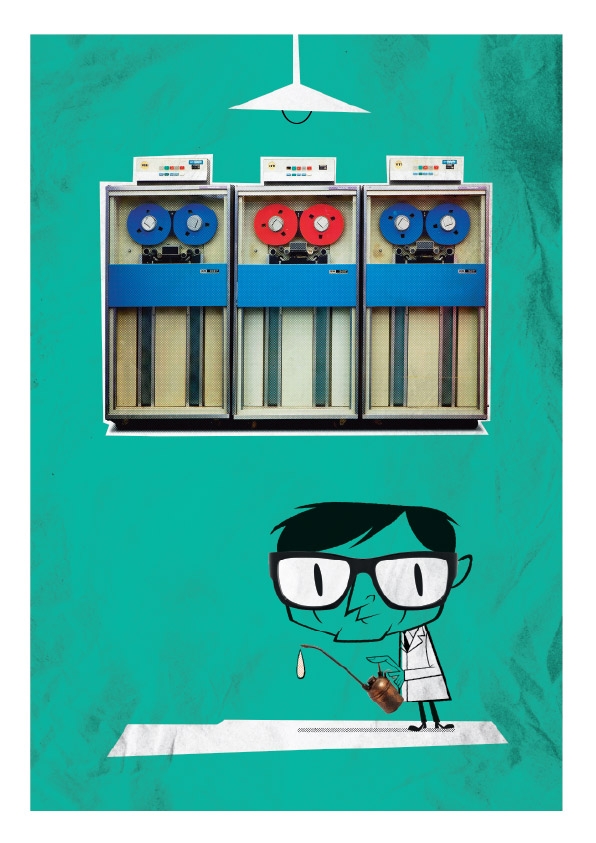
Illustration: Juan Roller (Estudio Perkins)
Illustration: Juan Roller (Estudio Perkins)
The difference between a project’s success and failure is hidden in a mystery box that we’re going to open today.
A question that is both simple and terrifying. Why does what really works work? The truth is that this is something that we’ve been wondering since the beginning of time, ever since someone rubbed two stones together and got a spark. We like to know. That’s just the way things are. We have an inquisitive spirit right from when we’re little; the one that spurs us to take a watch apart to find out how that mechanism works. They say that as we grow, that curiosity, that wanting to know everything, is lost a bit. We refuse to believe that.
LEADING TEAMS, UNDERSTANDING PEOPLE
Yes. It’s clear that humans are very fond of opening mystery boxes to find out what they have going on inside. Some have Schrödinger´s cat; others, the God Particle; and many others, things that are a little more trivial. The reason why something works is a recurring question, almost obsessive at times. As good old Jimmy Fontana said,
But what is it that makes the world go round?
The sciences have studied this for years, especially the social sciences, and have come to the conclusion that what makes things work is people. How? We don’t know exactly, but we just know. The cases of the most successful organisations and the most relevant projects have been analysed, and the results suggest that the key is to have the right people in the right context. People who seek to meet their needs individually. But not only those that Maslow told us about in his famous hierarchy. Three great needs have also been defined that we as human beings want to achieve.
The first of them is to have a good time, to really enjoy and have fun with what we do. The second is to feel like we are developing, like we are growing, culturally and emotionally, as people. American psychologist Howard Gardner wrote that when a person thinks they know, they age, but when they feel that they’re learning, they’re rejuvenated. The need to know, to prepare to face tasks, is paramount. And the third of those needs is to feel that we contribute something to the world. This feeling is known as generativity, and it’s nothing more than the desire to leave something here for when we’re no longer around. Because, as comedian Ignatius Farray says: “Life is just one small period of light between two eternal ones of darkness”. In truth, life is what’s extraordinary. That’s why human beings worry about transcending, about leaving a legacy here. Does the world shine a bit more because I was here? Or have I made it darker? Leaving a legacy is a need.

ONE FOR ALL AND ALL FOR BIG SCIENCE
OK, success relies on people, but when we say this, we do so in the plural. We’re gregarious animals. Creating societies is etched into our survival instinct. It’s belonging to tribes that has kept us from going extinct. That, and the fact that we still haven’t been put to the test with a giant meteorite… just watch the film “Don’t look up”.
People like to live in society; well, some more than others. We know that success, if there’s anything that can be defined as such, is only achieved in groups. In science, the same is true. This is what we’ve been calling "Big Science" for years. History is full of examples of what we’re talking about, big projects like the development of the atomic bomb, putting a human being on the Moon and even the most recent particle accelerator at the European Organisation for Nuclear Research (CERN). All of them have taught us that one plus one is a multitude. When all the players present in the system (both public and private) participate at the same time, in an orderly manner, and join forces, the results are much more efficient. Schools, universities, technological development centres, start-ups, and companies, all rowing in the same direction. That’s the key.
EMOTION AND INTELLECT
Indeed, we have the main ingredient in the recipe: people. People who have certain developmental needs and who interact in groups to achieve common goals. But then, why do things sometimes not work out? It’s not that they don’t work out… it’s that people alone are not enough.
More specifically, the main ingredient in the recipe is extremely volatile. We’re talking about people who have feelings and who relate through them. Ortega y Gasset said,
“I am myself and my circumstances”.
Well, when it comes to relating to each other, those circumstances multiply exponentially.
At a TED talk in which the audience was made up of executives from the world’s leading companies, those on hand were asked how many of them had been the top student in their classes. Of those in the packed auditorium, only a dozen people raised their hands. This makes it easy to see that intellectual abilities aren’t enough to succeed. In fact, American psychologist Daniel Goleman says that a person’s success can be quantified as 30% intellectual capacity and 70% emotional intelligence.
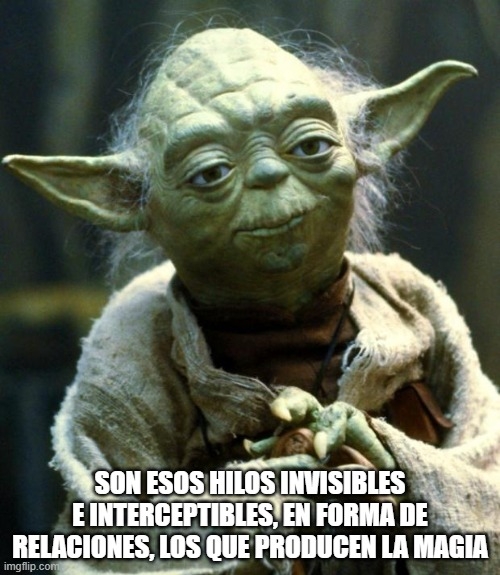
What makes projects work is the way in which people organise themselves, along with their abilities (both intellectual and emotional). One day Ferran Adrià was asked to summarise the key to success in a single idea, and he replied with the following:

It's those invisible and imperceptible threads, in the form of relationships, that produce the magic
O CAPTAIN, MY CAPTAIN
Having said this, that magic doesn’t just come along by itself: we have to elicit it. We have to create an ideal ecosystem. Traditionally, co-participation models dictated that for things to work, organisations had to extract value from participation in them. Now that’s not enough; now people must also extract value – in the form of knowledge, relationships, discovering other perspectives, or whatever else.
But this machine needs to be oiled. It needs something to make it work. This is why projects need leaders, captains to steer the ship. And notice that we didn’t say “bosses”. Instead, we’re referring to leadership, to the kind of person who is able to guide others, not only based on their hierarchical status, but also naturally. The latter is the most important thing. People who don’t need to show off their merits but are born leaders instead. People who roll up their sleeves, who participate, who know when it’s a good idea to give someone a pat on the back and, above all, who make other people in the organisation feel comfortable.

A PUZZLE WITH MILLIONS OF PIECES
In this case, we have one of those landscape puzzles with millions of pieces on our table, the kind that makes it almost impossible to tell one piece from another, but that, little by little, takes shape. So, we have a collective with shared leadership in which people feel comfortable, in which people are taken into consideration, letting them make decisions and giving them autonomy; in which there’s an idea to follow, an idea they tenaciously pursue because they see how it meets their needs. Perhaps you’ll recall that we talked about those needs at the beginning. Yes, they’re having fun with what they’re doing, they’re developing as individuals. But they’re also building something they believe in... thus, their passage through life is not vacuous. They leave a mark.
It is at this precise moment when people begin to give the best of themselves. They begin to contribute to the group because they’re going to receive much more, and they literally begin to put their heart and soul into what they are building. They become true ambassadors of what they’re doing.
And this, my friends, is how successful projects work; with sweat and tears, shared leadership, listening more, and talking less. With this, and a bit of luck, which always comes in handy.
This is how projects like Quantum Ecosystem are approached. Almost infinite talent combined with an attitude brimming with excitement, literally putting everything we’ve got into an idea. As the Japanese poet Ryunosuke Satoro said:
“Individually, we’re a drop; together, an ocean”.
Let’s be an ocean.
Take our advice and check it out
Slide to show more