The inheritance of heritage
#Done
04.17.2023 Reading time: 5 minutes
BizkaiaTech editorial team
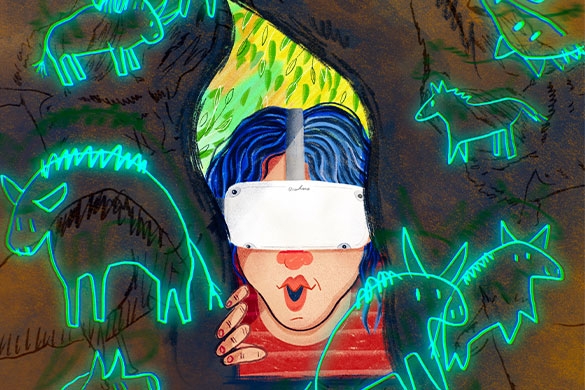
Illustration:
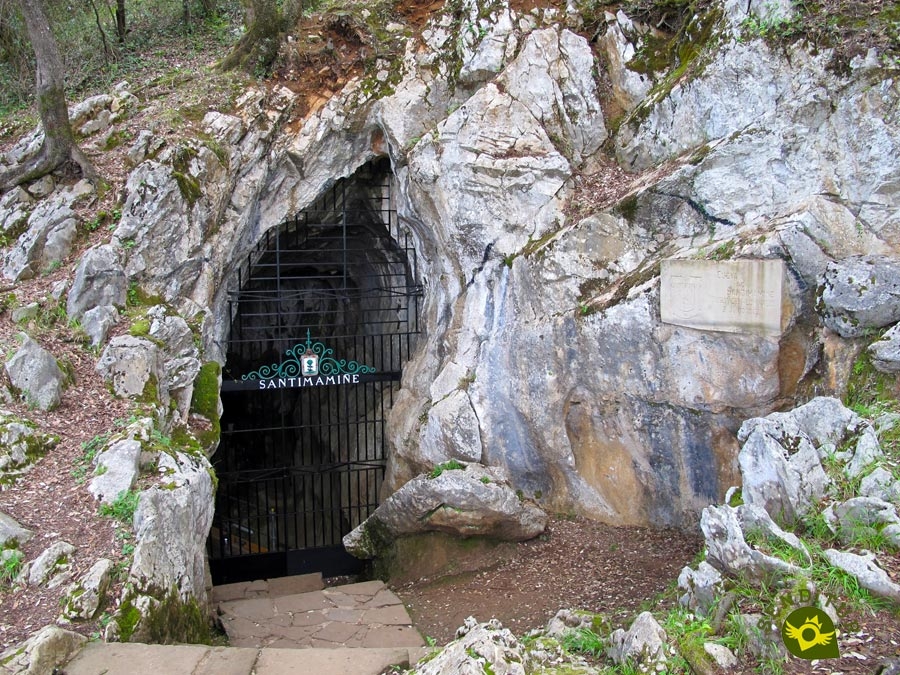
Anyone who was born before the year 2000 knows what it’s like to spend the day at the Santimamiñe Cave. Grabbing a sandwich and getting on the school bus, or in your family’s car to go into the forest, see the spectacular landscapes of Busturialdea, climb a lot of stairs, and reach Biscay’s most important heritage site.
There, we had the chance to visit some narrow but wonderful caves and see cave paintings that date back more than 14,000 years – an unforgettable experience to take back home with us. Even so, beginning in November of 2006 these nice day trips had to be replaced by ones to the Oma Forest, Basondo, the Guggenheim Museum, or a guided tour of San Mamés Stadium, because the Santimamiñe Cave closed its doors to visitors.
BEFORE IT WAS TOO LATE
The cave was closed because the experts were worried about this heritage site being degraded. This cave and the wonders within it were found between 1918 and 1962. Since then, work was done so that everyone could enjoy these treasures. As the years went by, however, researchers realized that the state of the cave paintings was deteriorating. The reasons for that deterioration were the following: firstly, the experts said that the resources used so that the public could see the pieces were very detrimental to their condition, especially the lighting. According to them, the lit-up areas (especially those that were continuously lit up) were beginning to develop microorganisms, and vegetation. In addition, the lighting changed the natural temperature inside the cave, altering the conditions that had preserved the paintings so well for all those years. The metal infrastructure also caused rust and condensation, hampering preservation of the heritage site.
What’s more, the human factor also had a lot to do with the closure of Santimamiñe, since daily visits to the cave produced a lot of CO2. Also detrimental was the dust that got kicked up by all the movement, and the dirt that was brought in from outside. Precautions were taken in 1997, when the number of visitors allowed to enter at once was reduced, and some galleries were closed. These measures, however, were not enough to avert further damage, so they proceeded to close the cave.
This left two options on the table: either they let young people learn about the history of the cave through photos and stories, transmitted orally, or they could do something different and innovative so that everyone had the opportunity to see this piece of our cultural heritage first-hand. Can you guess which option was decided on?
PRECURSORS OF THE METAVERSE
You hit the nail on the head. The Government of Biscay, with the help of Virtualware, got to work on something new to give this piece of cultural heritage a new lease on life. This project was carried out in 2008, believe it or not, shortly after the cave was closed to visitors.
To begin with, they used a laser scanner to scan the entire cave in 3D. They did this by taking more than 1,500 photos and identifying more than 6 billion data points. In addition to scanning the physical space, they also had to capture other features that made up the cave; for example, the outlines of the paintings, the sounds heard within the cave walls, and videos of the visit’s path.
After gathering all this data, it was time to create the virtual model. First, they had to process all the information they had collected, focusing a lot on the colors and the lighting. When they got that just right, they put photorealistic textures in the model, aiming to make the visitors feel like they were inside the cave. After this, the virtual cave was ready (just like that…). Creating the application was the next step, in which they had to design the path that people would follow: camera movements, multimedia points, etc. When finished, all that remained was to create the space where the experience would take place; that is, the production.
And voilà! Ready for visitors! If we want to go there (after making a reservation, of course), a guide will take us to the entrance of the cave, where the visit begins. After a brief explanation providing a bit of context, we set off to the room where the experience is had, where we don the famous VR headset. This headset will transport us directly to the Santimamiñe Cave, giving us the chance to visit all the important parts we want to learn about, all the while hearing the story of our ancestors. Visits usually last an hour and a half, and there are four languages available so that everyone can feel part of the experience: Basque, Spanish, English, and French.
WHAT DOES THE FUTURE HOLD?
We know that the project to convert Santimamiñe into a virtual replica was very innovative, and, together with other similar projects (virtual Cádiz, virtual Rome), it brought the use of technology to promote culture to the fore. Even so, a lot of time has passed since then. Ignorance towards technology has become an excuse, and the concepts of the metaverse and digital twins have never been as popular as they are today. Could we take advantage of this conversation to promote and learn more about our own culture?
You may be thinking… “All this is great, but… it’s always much better to see historical sites with your own eyes. Why would I want to wear a headset to see the Eiffel Tower? Besides that... I can just Google it and see photos whenever I want.” Luckily, in most cases, one thing is not going to replace the other. Virtual Reality and the metaverse can be the ideal complement when it comes to promoting culture. Can’t take your class of 30 students to London so they can see Van Gogh’s “Sunflowers?” Bam! Through a virtual museum they’ll be able to see even the painting’s most detailed brushstrokes. Can’t walk the streets of Rome to see all it has to offer? Bam! Through a virtual guided tour you’ll be able to visit every corner of this magical city.
This can also be a way to prevent the kind of damage that mass tourism has done in recent years. It’s nice to have deep pockets, but the price we pay for cultural heritage is very, very high.
Apart from this, in cases like the Santimamiñe Cave, this technology helps us to protect something that is so much ours, and that we love so much, all the while teaching our culture and history to future generations. The cave’s closure has also helped us to learn more about our history, as it has made it possible for researchers to explore the cave without any problem.
Thanks to technology, the Santimamiñe Cave has had a second chance to show everyone one of the most beautiful gems that Biscay has to offer. Let’s take this opportunity to learn a little more about where we came from.
Labels
- #cultura
- #innovación
- #futuro
- #educación
- #metaverso
Take our advice and check it out
Slide to show more
Cookies
We use proprietary and third-party cookies for technical, analytical and customisation purposes, such as choosing the language in which to display the website. For more information, please consult our cookies policy (Opens modal window).
Cookies policy
The website at https://www.bizkaia.eus (hereinafter, the Website) uses tools to track browsing activity on the website and the IP address of the service recipient for the purpose of improving and guaranteeing the provision of services or technical operation of the website, distinguishing you from other users and analysing your browsing habits.
This Cookies Policy seeks to inform you clearly and precisely about the operation and function of the cookies we use.
What are cookies and why do we use them?
A cookie is a file that is downloaded to your computer when accessing certain websites.
Cookies enable a website to, among other things, store and recover information about the browsing habits of a user or their device and, depending on the information contained and the way in which the same is used by the device, may be used to recognise the user.
Current law allows us to store cookies on your device if they are strictly necessary for operation of this website. However, we need permission for all other cookies.
Types of cookies based on the managing entity
Depending on who manages the computer or domain from where the cookies are sent and who processes the data obtained, a distinction can be made between the following types of cookies:
- Proprietary cookies: these are managed by the Provincial Council of Biscay.
-
Third-party cookies: these are managed by another entity, which processes the data obtained via the cookies.
This website may contain cookies belonging to the Basque Government, used for its own purposes and stored by domains other than those owned by the Bizkaia Provincial Council.
Types of cookies based on their purpose
- Technical cookies: these allow the user to browse a website, platform or application and to use the various options or services available, such as control data traffic and communication, identify the session, access restricted areas, request registration or participation in an event, use security elements while browsing, store content for video or audio playback, or share content via social media networks.
- Customisation cookies: these allow the user to access the service with some general characteristics predefined according to a series of criteria on the user’s device, such as the language, type of browser being used to access the service, regional configuration from where the service is accessed, etc.
- Analysis cookies: these allow the number of users to be counted and the browsing activity to be statistically measured and analysed for the purpose of improving the services made available. They may be proprietary or third-party cookies.
Duration of the cookies
- Session cookies: these collect and store data while the user is visiting a website.
- Persistent cookies: the data are stored on the device in an ongoing fashion and may be accessed and processed during a period defined by the cookie manager, which may range from a few minutes to several years.
Which cookies does this website use?
In each row you can find data relating to Technical cookies
| Name | Purpose | Duration | Owner |
|---|---|---|---|
| JSESSIONID | Session identifier | Session | Bizkaia Provincial Council |
| ASPSESSIONID | Session identifier | Session | Bizkaia Provincial Council |
| TS01 | Session identifier | Session | Bizkaia Provincial Council |
| LFR_SESSION_STATE | Session identifier | Session | Bizkaia Provincial Council |
| COOKIE_SUPPORT | Indicate whether the user has the cookie support activated | 1 year | Bizkaia Provincial Council |
| pc_tecnicas_bizkaia | Choose your preferences for acceptance of the block of technical cookies | 1 year | Bizkaia Provincial Council |
| pc_analitica_bizkaia | Choose your preferences for acceptance of the block of analytical cookies | 1 year | Bizkaia Provincial Council |
| pc_preferencias_bizkaia | Choose your preferences for acceptance/rejection of the block of preferential cookies | 1 year | Bizkaia Provincial Council |
| pc_terceros_bizkaia | Choose your preferences for acceptance/rejection of the block of third-party cookies | 1 year | Bizkaia Provincial Council |
| Kultursistema_session | Keeping the user’s session | 1 year | Kultursistema |
| CPLB | Contains information used by our load-balancing servers | Session | Provincial Council of Biscay |
| XSRF-TOKEN | To prevent CSRF (Cross-Site Request Forgery) attacks | 1 year | Kultursistema |
| _GRECAPTCHA | Protects the website from spam and brute-force attacks | 5 months |
In each row you can find data relating to Analysis cookies
| Name | Purpose | Duration | Owner | |
|---|---|---|---|---|
| dtCookie | Track a visit through multiple requests | Session | Bizkaia Provincial Council | |
| dtLatC | Measure the latency of the server to monitor performance | Session | Bizkaia Provincial Council | |
| dtPC | Necessary to identify the appropriate parameters for beacon transmission; includes session ID for correlation | Session | Bizkaia Provincial Council | |
| dtSa | Intermediate storage for actions spanning pages | Session | Bizkaia Provincial Council | |
| rxVisitor | Visitor ID to correlate sessions | Constantly | Bizkaia Provincial Council | |
| rxvt | Session waiting time | Session | Bizkaia Provincial Council | |
| iyrc-user-id | Distinguish users | 1 year | Bizkaia Provincial Council | |
| _ga, _ga_XXXXXXXXXXX | Analysis | To distinguish users | 2 years | Google Analytics |
| _gat, _gat_XXXXXXXXXXX | Analysis | To limit the percentage of requests | 1 minute | Google Analytics |
| _gid | Analysis | To distinguish users | 1 day | Google Analytics |
In each row you can find data relating to Personalisation cookies
| Name | Purpose | Duration | Owner |
|---|---|---|---|
| Idioma | Select the language preferred by the user | 1 year | Bizkaia Provincial Council |
| cookie-tramites-favs | Save favourite procedures in Prior Appointment | 1 year | Bizkaia Provincial Council |
In each row you can find data relating to Third-party cookies
| Name | Purpose | Duration | Owner |
|---|---|---|---|
| CLID | Identify a user’s first visit | 1 year | Microsoft Clarity |
| APISID | Store user preferences and information during page views with Google maps in them. | 2 years | |
| HSID | Store user preferences and information during page views with Google maps in them. | 2 years | |
| MUID | Store user preferences and information during page views with Google maps in them. | 1 year | Microsoft Clarity |
| NID | Remember their preferences and other information | 6 months | |
| SAPISID | Show personalised advertisements on Google sites | 2 years | |
| SID | Provide advertisement delivery or retargeting, provide fraud prevention. | 2 years | |
| SIDCC | Provide reliable web traffic identification. | 1 year | |
| SM | Used to synchronise the MUID between Microsoft domains. | Session | Microsoft Clarity |
| SSID | Provide advertisement delivery or retargeting, provide fraud prevention. | 2 years | |
| __Secure-1PAPISID | Create a website visitor interest profile to show relevant and personalised Google advertising. | 2 years | |
| __Secure-1PSID | Create a website visitor interest profile to show relevant and personalised Google advertising. | 2 years | |
| __Secure-1PSIDCC | Create a website visitor interest profile to show relevant and personalised advertising through retargeting. | 1 year | |
| __Secure-1PSIDTS | Create a website visitor interest profile to show relevant and personalised advertising through retargeting. | 1 year | |
| __Secure-3PSID | 2 years | ||
| __Secure-3PSIDCC | Create a website visitor interest profile to show relevant and personalised advertising through retargeting. | 1 year | |
| __Secure-3PSIDTS | Create a website visitor interest profile to show relevant and personalised advertising through retargeting. | 1 year | |
| __Secure-ENID | Necessary cookies to use website services and options | 1 year | |
| ar_debug | Refine advertisements. | 1 año | |
| MR | Indicate when MUID is refreshed | 6 months | Microsoft Clarity |
| XSRF-TOKEN | Indicate when MUID is refreshed | 1 hour | Kultursistema |
| _fbp | Store and track website visits | 1 year | |
| kultursistema_session | Keep the user’s session | 1 hour | Kultursistema |
| AEC | Detect spam, fraud, and abuse | 6 months | |
| SOCS | Store user cookies preferences | 13 months | |
| Locale | not available | Basque government | |
| _hegoa_coop_session | Create a session ID for users | Session | Basque government |
How to deactivate or delete cookies?
When first accessing the Website, the user may configure and accept or reject the cookies on this Website. Subsequently, the user may change or withdraw their consent at any time via this Cookies Policy or the settings page.
However, you may exercise your right to freely deactivate them and even delete the cookies on this Website at any time. This is done differently depending on which browser you are using. Here is a quick guide for the most popular browsers.
- Deactivate Cookies in Chrome
- Deactivate Cookies in Explorer
- Deactivate Cookies in Firefox
- Deactivate Cookies in Safari
- Deactivate Cookies in Edge
If you deactivate or delete cookies, certain features of the Website may no longer function correctly.
Changes to the Cookies Policy
The Website reserves the right to change this Cookies Policy under the terms provided for by current legislation. We therefore recommend that you revise this policy each time you access our website to see any changes and read the pertinent information.
Configure cookies
We show you hereinbelow the different categories of cookies that our web page uses. You can personalise your choice by accepting or rejecting these categories through the buttons enabled to that end. For more information, consult our cookies policy (Opens modal window).
-
Technical Always active
These are needed to allow browsing on our website and for basic tasks related to correct website operation.
