The brain switches on and off, and then... EUREKA!

#Done
03.02.2023
BizkaiaTech editorial team
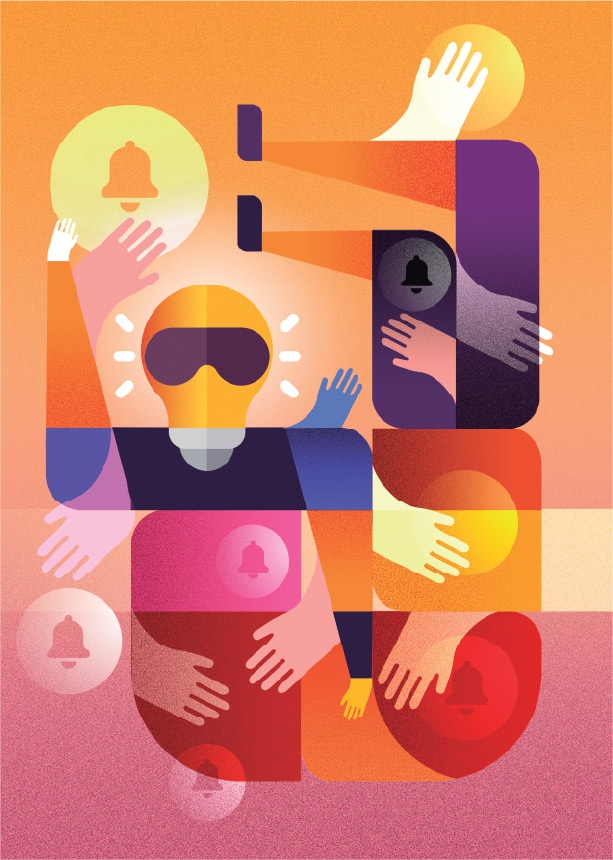
Ilustration: Hopper Ink
Eureka moments are as valued as they are prized, but who manages to have one?
The story goes that the Greek mathematician, inventor, and physicist Archimedes uttered this word after figuring out whether King Hiero II’s crown was made of pure gold or another similar material of inferior quality.

Many believe that eureka moments come to you like divine revelations that hit you in the middle of the night. But the truth is that behind each eureka moment there are hours of work and a long process involving an idea, experimentation, and development.
Returning to the present, and not far from here, some geniuses in their fourth year of secondary school have been tirelessly chasing the eureka moment… what for? To solve the challenge posed this year by the USA’s “Global Innovation Award” science and technology contest. What was it? Well, nothing more and nothing less than getting people to play sports, or facilitating the practice of sports that are not well known… but, wait, hasn’t everything for sports already been invented? Well, it looks like that’s not the case.
From November to January, during the Technology and Scientific Culture class hours, and some breaks, at the Begoñazpi “Ikastola” (a type of Basque school), the team of sixteen-year-olds got down to work. They exhaustively pondered new options and alternatives: “How can we innovate and help at the same time?” “What sport do we choose?” And the most common and difficult question: “Where do we start?”
Clearly, innovating requires us to reprogram the way we’ve been taught to think. But often, either due to a lack of time, or saturation at schools, we’re not taught to develop imagination, critical thinking skills, and the curiosity to drive learning. Rather, we’re taught to memorise, regurgitate facts and figures, and do homework, but… what happens when we let autonomous thought (you know, the kind of thought that arises from innate curiosity, from genuinely wanting to know more) shine through?
This team of young people are a clear example of that renewed, curious, and restlessly inquisitive mentality. Faced with the challenge, they thought outside the box in such a natural way that it amazes us: they sought out an unusual sport category, Goalballa,, the only Paralympic sport created specifically for blind and partially-sighted people in which all the players wear opaque goggles, to even out the playing field, as it were. Interesting, right? Well, even more interesting are the dynamics of the game: it’s mainly based on hearing, using sound to detect the path of the ball (which has bells inside). It also requires great spatial ability in order to be in the best place on the field at all times, as one strives to intercept or throw the ball into the other team’s goal.
Upon reading that description, it may seem like a simple game… but nothing could be further from the truth.
We spoke with a Paralympic player, and she told us that,
“The main problem for players occurs when they get spatially lost on the field. After all, you have to be paying a lot of attention to recognise what position you’re in at all times”.
“If you get lost, you go back to the goal and, from there, to a corner… and then you find your place again. This time is very valuable. Often it’s when the other team scores on you.”
In order to come up with a solution that would really be useful to them, they started at the beginning: understanding the players and playing like them to detect possible problems.
The laser was the first option that this team from Biscay thought of to find a solution. The idea was to design a grid with sensors to detect where the players are. But, of course, when the ball or any other element passed, the information wasn’t going to be exact.
The head is…headstrong, and wants to find quick solutions. Thus, when it doesn’t, it freezes up easily. But there comes a time when, after turning things around in your mind and ruling out combinations that don’t work, a hypothesis is produced that seems feasible.
What if we designed a system linked to a bracelet so that players could locate themselves with the help of a camera? Eureka!
There’s nothing that stimulates the mind of this new generation of geniuses more than a challenge that will improve people’s lives.
In this case, the team knew that if they succeeded, the result would be something necessary and satisfying for many other people. Therefore, they didn’t lack motivation and desire… they just needed a little push: learning a new language. Just as we learned to write by trying, making mistakes, and trying again, they had to learn a new language based on the Python source code. Armed with humble yet powerful tools, they began to teach themselves about different technologies. Hours and hours of self-taught programming, tests with Raspberry Pi (they needed a cheap, small, and quality system), and a model that reproduced a miniature Goalball field, for them to experiment, create, and take risks.
They started by detecting the movement of an object on the field, adding Arduino modules for the signals. As a result, they designed a device that scans the playing field every second, comparing the original photo with the one taken at any given time. If an anomaly is detected, they mark it and extract information about the players’ coordinates, which are processed and sent by radio frequency signals to the bracelet being worn. Thus, when a player gets into their position, they will receive a vibration lasting 1.5 seconds. When they leave their position, they get a vibration lasting 0.5 seconds. This allows players to know when they are in position, when they aren’t, and how many steps they’ve taken.
These students’ ingenuity, creativity, collaboration, and critical thinking skills made them finalists for the “Global Innovation Award” ,competing worldwide.
Who knows if the next steps will be to adapt this system to sports or home automation for people with vision impairments. There’s no challenge that daunts them.
What is clear is that the eureka moment seems to arrive by chance, but it actually hinges on hours of work, reading, and curiosity about unconnected topics.
The truth is that our brain is capable of creating incredible connections in creative and innovation processes. What comes to us suddenly, or out of context, at first glance, like Archimedes in his bathtub, really happens thanks to connections that seek commonalities between different thoughts.
A long-distance race that begins with a: “Where do we start?”
Take our advice and check it out
Slide to show more