Quantum in Your Living Room

#Reflections
09.13.2024 Reading time: 5 minutes
BizkaiaTech editorial team
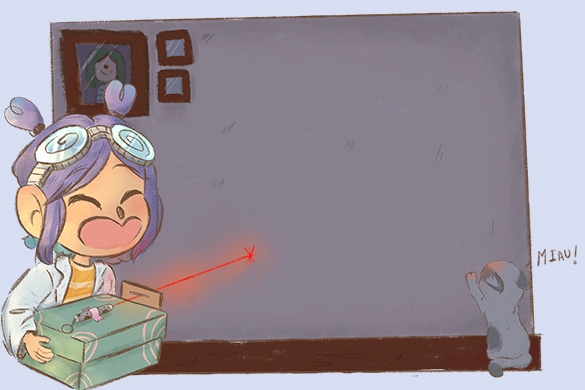
Ilustration: Arima
Everyone remembers school science experiments because, along with sports day (and the last day of school, oops), it used to be the best day of the school year. The volcanoes, the balloons that didn't pop when pricked, the stacked cups, the water and oil… oh, what we’d give to go back…
To relive those exciting days, we bring you a somewhat... peculiar experiment. Unfortunately, this time, nothing will erupt, you won't get your hands dirty, and you won't have to do anything that gives you a crazy adrenaline rush. Yeah, it's a shame, we know. But subatomic particles don't do those things. Yes, you read that right: subatomic particles. Can you even do experiments with something you can't see? Of course! We'll show you how (and why).
So… if you want to understand quantum phenomena better and only using things you (mostly) find at home, you're in the right place. Prepare your tools and let's go!
Light Diffraction: What Am I Seeing?
You’ll need…
- A laser pointer.
- A small piece of cardboard or aluminum foil.
- Scissors.
- Glue or tape.
- A white wall.
* Warning: Never point the laser at anyone (or yourself) as it can be very harmful. Use it only for the experiment.
Objective:
Try to pass the laser pointer's light through a small slit to see the pattern it creates on the wall (you'll be surprised).
How to do it:
- Take the cardboard and scissors and try to make a very narrow slit (about the width of the scissor blade) about 5 cm long.
- Once you have the slit, place the laser pointer and the piece of cardboard with the slit at the same height, about 10 cm apart. You can use any surface and stick both items with tape or glue.
- It's important that they are at the same height so that the laser light passes exactly through the slit.
- It's also important to have the white wall behind it so the light projects there and can be seen clearly.
- When everything is set up, just turn off the lights and voilà! You can observe the diffraction pattern the light makes. Isn't it cool?.
A plus: If getting a laser pointer gets impossible, there's something much simpler you can do: take a piece of aluminum foil and make a super, super small hole with a pin. If you bring that piece of paper close to your eye, you should also see the diffraction effect.
Why does this happen?
What everyone thinks when passing light through a slit is that the light will be projected on the wall in the same shape as the slit, right? Well, in the case of monochromatic lights (the laser, in this case) it's not so.
In this case, the light behaves like a wave, and passing through a narrow slit, instead of traveling in a straight line, it spreads through the slit, coming out in different directions. It's the same as when you throw a stone in water. See how the waves form circles around the stone? If you replace water with light, the phenomenon is exactly the same.
And what does this have to do with quantum physics? Diffraction itself has nothing to do with them, but it’s a good way to illustrate how particles work because, as we know, they can exhibit both wave and particle behaviors. In summary, light also has a dual nature, behaving as a particle or a wave, in this case, as it interacts with the slit we’ve placed as an obstacle.
Take our advice and check it out
Slide to show more