Passing Without Leaving a Trace
#Reflections
03.24.2025 Reading time: 3 minutes
BizkaiaTech editorial team
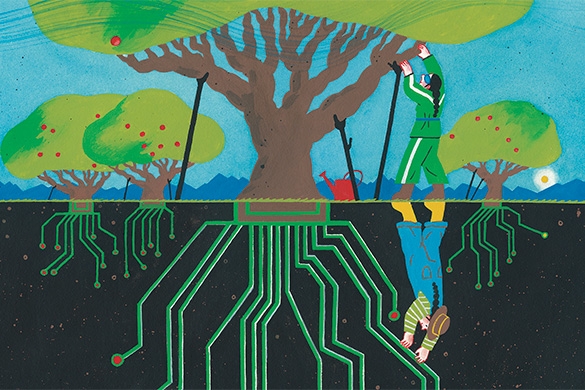
Ilustration: Maite Gurrutxaga
Technological advancements have transformed the way we live, produce, and consume. But they also bring a major challenge: making it sustainable. Undoubtedly, innovation can drive the ecological transition and improve our relationship with the planet, but it also generates a significant environmental footprint.
This issue is dedicated to exploring how technological tools and the habits that rely on them can be allies in building a sustainable future. In the following pages, we highlight initiatives launched by public and private entities to achieve this goal or simply to raise awareness about it. And, of course, we explain the key concepts you should keep in mind to navigate this green movement with ease.
PAY ATTENTION
The Energy Intelligence Center (EIC) is a project in Biscay that showcases how public-private collaboration can support one of the key pillars of new environmental policies: industrial decarbonization. It is a commitment to innovation in hydrogen technologies and renewable fuels that also fosters education and attracts talent.
The Fediverse presents itself as a fairer and more sustainable digital alternative. This decentralized Internet model not only protects privacy and data sovereignty but also aims to reduce the environmental impact of centralized digital infrastructures, which, as we will see, consume enormous amounts of energy. In other words, it offers a different way to interact in the digital space without compromising the planet’s resources.
Food is another key pillar of sustainability that is undergoing a technological revolution. From using artificial intelligence to reduce waste to developing new foods such as lab-grown meat, the food industry is exploring more efficient and environmentally friendly solutions. The circular economy is gaining traction with initiatives that turn waste into useful resources, while automation and digitalization optimize food production and distribution.
Artificial intelligence, with its enormous potential, also raises questions about its environmental impact. Increasingly complex models require a staggering amount of energy. This is where tensor networks inspired by quantum physics can make a difference, offering a more efficient and sustainable alternative for AI development.
The ecological transition, far from being just a challenge, represents an opportunity to generate employment, investment, and the emergence of new technological solutions. Artificial intelligence, blockchain, and renewable energies are driving the creation of innovative materials and traceability systems for more effective waste management. However, to make these initiatives viable, it is crucial to have demonstration spaces, proper funding, and public policies that encourage change.
START SMALL, THINK BIG
Technology is not inherently eco-friendly. It is how we use it that truly makes the difference. That’s why it’s worth reconsidering our habits when making a purchase, for example. Would you know the carbon footprint of a purchase from a major e-commerce platform? Reflecting on the "hidden cost" of digitalization is key to making more responsible consumer choices and demanding greater transparency from companies.
Finally, to wrap up this issue, we encourage you to put on your apron and try out a zero-waste recipe.
Technology and sustainability don’t have to be in conflict, but their coexistence requires a conscious and strategic approach. The future depends on how we choose to use technology today.
Enjoy the read!
Labels
- #startup
- #quantum
- #bigscience
- #tecnología
- #estrategia
- #futuro
- #sostenibilidad
- #naturaleza
Take our advice and check it out
Slide to show more
Cookies
We use proprietary and third-party cookies for technical, analytical and customisation purposes, such as choosing the language in which to display the website. For more information, please consult our cookies policy (Opens modal window).
Cookies policy
The website at https://www.bizkaia.eus (hereinafter, the Website) uses tools to track browsing activity on the website and the IP address of the service recipient for the purpose of improving and guaranteeing the provision of services or technical operation of the website, distinguishing you from other users and analysing your browsing habits.
This Cookies Policy seeks to inform you clearly and precisely about the operation and function of the cookies we use.
What are cookies and why do we use them?
A cookie is a file that is downloaded to your computer when accessing certain websites.
Cookies enable a website to, among other things, store and recover information about the browsing habits of a user or their device and, depending on the information contained and the way in which the same is used by the device, may be used to recognise the user.
Current law allows us to store cookies on your device if they are strictly necessary for operation of this website. However, we need permission for all other cookies.
Types of cookies based on the managing entity
Depending on who manages the computer or domain from where the cookies are sent and who processes the data obtained, a distinction can be made between the following types of cookies:
- Proprietary cookies: these are managed by the Provincial Council of Biscay.
-
Third-party cookies: these are managed by another entity, which processes the data obtained via the cookies.
This website may contain cookies belonging to the Basque Government, used for its own purposes and stored by domains other than those owned by the Bizkaia Provincial Council.
Types of cookies based on their purpose
- Technical cookies: these allow the user to browse a website, platform or application and to use the various options or services available, such as control data traffic and communication, identify the session, access restricted areas, request registration or participation in an event, use security elements while browsing, store content for video or audio playback, or share content via social media networks.
- Customisation cookies: these allow the user to access the service with some general characteristics predefined according to a series of criteria on the user’s device, such as the language, type of browser being used to access the service, regional configuration from where the service is accessed, etc.
- Analysis cookies: these allow the number of users to be counted and the browsing activity to be statistically measured and analysed for the purpose of improving the services made available. They may be proprietary or third-party cookies.
Duration of the cookies
- Session cookies: these collect and store data while the user is visiting a website.
- Persistent cookies: the data are stored on the device in an ongoing fashion and may be accessed and processed during a period defined by the cookie manager, which may range from a few minutes to several years.
Which cookies does this website use?
In each row you can find data relating to Technical cookies
| Name | Purpose | Duration | Owner |
|---|---|---|---|
| JSESSIONID | Session identifier | Session | Bizkaia Provincial Council |
| ASPSESSIONID | Session identifier | Session | Bizkaia Provincial Council |
| TS01 | Session identifier | Session | Bizkaia Provincial Council |
| LFR_SESSION_STATE | Session identifier | Session | Bizkaia Provincial Council |
| COOKIE_SUPPORT | Indicate whether the user has the cookie support activated | 1 year | Bizkaia Provincial Council |
| pc_tecnicas_bizkaia | Choose your preferences for acceptance of the block of technical cookies | 1 year | Bizkaia Provincial Council |
| pc_analitica_bizkaia | Choose your preferences for acceptance of the block of analytical cookies | 1 year | Bizkaia Provincial Council |
| pc_preferencias_bizkaia | Choose your preferences for acceptance/rejection of the block of preferential cookies | 1 year | Bizkaia Provincial Council |
| pc_terceros_bizkaia | Choose your preferences for acceptance/rejection of the block of third-party cookies | 1 year | Bizkaia Provincial Council |
| Kultursistema_session | Keeping the user’s session | 1 year | Kultursistema |
| CPLB | Contains information used by our load-balancing servers | Session | Provincial Council of Biscay |
| XSRF-TOKEN | To prevent CSRF (Cross-Site Request Forgery) attacks | 1 year | Kultursistema |
| _GRECAPTCHA | Protects the website from spam and brute-force attacks | 5 months |
In each row you can find data relating to Analysis cookies
| Name | Purpose | Duration | Owner | |
|---|---|---|---|---|
| dtCookie | Track a visit through multiple requests | Session | Bizkaia Provincial Council | |
| dtLatC | Measure the latency of the server to monitor performance | Session | Bizkaia Provincial Council | |
| dtPC | Necessary to identify the appropriate parameters for beacon transmission; includes session ID for correlation | Session | Bizkaia Provincial Council | |
| dtSa | Intermediate storage for actions spanning pages | Session | Bizkaia Provincial Council | |
| rxVisitor | Visitor ID to correlate sessions | Constantly | Bizkaia Provincial Council | |
| rxvt | Session waiting time | Session | Bizkaia Provincial Council | |
| iyrc-user-id | Distinguish users | 1 year | Bizkaia Provincial Council | |
| _ga, _ga_XXXXXXXXXXX | Analysis | To distinguish users | 2 years | Google Analytics |
| _gat, _gat_XXXXXXXXXXX | Analysis | To limit the percentage of requests | 1 minute | Google Analytics |
| _gid | Analysis | To distinguish users | 1 day | Google Analytics |
In each row you can find data relating to Personalisation cookies
| Name | Purpose | Duration | Owner |
|---|---|---|---|
| Idioma | Select the language preferred by the user | 1 year | Bizkaia Provincial Council |
| cookie-tramites-favs | Save favourite procedures in Prior Appointment | 1 year | Bizkaia Provincial Council |
In each row you can find data relating to Third-party cookies
| Name | Purpose | Duration | Owner |
|---|---|---|---|
| CLID | Identify a user’s first visit | 1 year | Microsoft Clarity |
| APISID | Store user preferences and information during page views with Google maps in them. | 2 years | |
| HSID | Store user preferences and information during page views with Google maps in them. | 2 years | |
| MUID | Store user preferences and information during page views with Google maps in them. | 1 year | Microsoft Clarity |
| NID | Remember their preferences and other information | 6 months | |
| SAPISID | Show personalised advertisements on Google sites | 2 years | |
| SID | Provide advertisement delivery or retargeting, provide fraud prevention. | 2 years | |
| SIDCC | Provide reliable web traffic identification. | 1 year | |
| SM | Used to synchronise the MUID between Microsoft domains. | Session | Microsoft Clarity |
| SSID | Provide advertisement delivery or retargeting, provide fraud prevention. | 2 years | |
| __Secure-1PAPISID | Create a website visitor interest profile to show relevant and personalised Google advertising. | 2 years | |
| __Secure-1PSID | Create a website visitor interest profile to show relevant and personalised Google advertising. | 2 years | |
| __Secure-1PSIDCC | Create a website visitor interest profile to show relevant and personalised advertising through retargeting. | 1 year | |
| __Secure-1PSIDTS | Create a website visitor interest profile to show relevant and personalised advertising through retargeting. | 1 year | |
| __Secure-3PSID | 2 years | ||
| __Secure-3PSIDCC | Create a website visitor interest profile to show relevant and personalised advertising through retargeting. | 1 year | |
| __Secure-3PSIDTS | Create a website visitor interest profile to show relevant and personalised advertising through retargeting. | 1 year | |
| __Secure-ENID | Necessary cookies to use website services and options | 1 year | |
| ar_debug | Refine advertisements. | 1 año | |
| MR | Indicate when MUID is refreshed | 6 months | Microsoft Clarity |
| XSRF-TOKEN | Indicate when MUID is refreshed | 1 hour | Kultursistema |
| _fbp | Store and track website visits | 1 year | |
| kultursistema_session | Keep the user’s session | 1 hour | Kultursistema |
| AEC | Detect spam, fraud, and abuse | 6 months | |
| SOCS | Store user cookies preferences | 13 months | |
| Locale | not available | Basque government | |
| _hegoa_coop_session | Create a session ID for users | Session | Basque government |
How to deactivate or delete cookies?
When first accessing the Website, the user may configure and accept or reject the cookies on this Website. Subsequently, the user may change or withdraw their consent at any time via this Cookies Policy or the settings page.
However, you may exercise your right to freely deactivate them and even delete the cookies on this Website at any time. This is done differently depending on which browser you are using. Here is a quick guide for the most popular browsers.
- Deactivate Cookies in Chrome
- Deactivate Cookies in Explorer
- Deactivate Cookies in Firefox
- Deactivate Cookies in Safari
- Deactivate Cookies in Edge
If you deactivate or delete cookies, certain features of the Website may no longer function correctly.
Changes to the Cookies Policy
The Website reserves the right to change this Cookies Policy under the terms provided for by current legislation. We therefore recommend that you revise this policy each time you access our website to see any changes and read the pertinent information.
Configure cookies
We show you hereinbelow the different categories of cookies that our web page uses. You can personalise your choice by accepting or rejecting these categories through the buttons enabled to that end. For more information, consult our cookies policy (Opens modal window).
-
Technical Always active
These are needed to allow browsing on our website and for basic tasks related to correct website operation.
