Our Network, Our Rules

#Tech bay
06.11.2025 Reading time: 5 minutes
BizkaiaTech editorial team
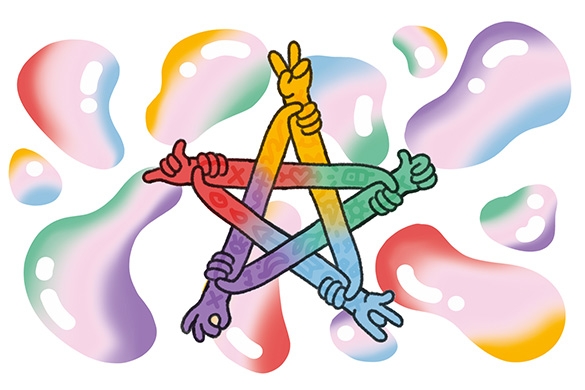
Illustration: Gorka Gil
When we use social media, we somehow know that we’re making a pact with the devil. Elon Musk, Mark Zuckerberg, Jeff Bezos, and other technocrats use our data and the information we’ve given them for free to fatten their wallets even more, but we don’t care. As long as we can spend hours scrolling on Instagram… it’s all good. However, there is a way to use social networks in a decentralized and interconnected way, a way where we wouldn’t have to make a pact with the devil; yes, you guessed it: the fediverse.
LOCAL PRODUCE
Furthermore, there’s a small corner of the Internet where anyone can use social media exclusively in euskera: it’s known as the Euskal fedibertsoa (Basque fediverse), and its goal is to offer a space to talk, share photos, comment, or do anything else using the Basque language.
Abaraska taldea, a group formed by people working in the field of free software and Basque language, has been involved in this adventure since 2020, aiming to achieve that goal. Mikel Gartzia Santamaria is one of the members of this group, and we’ve had the chance to chat with him to explore all the corners of the Basque fediverse.
SEEDS AND MUSHROOMS
As Mikel says, “mushrooms don’t grow out of nowhere,” and Abaraska taldea, in the same way, didn’t arise from nothing. It was the group called Librezale who planted the seed for all of this. The people in that group, who were mainly focused on translating software into Basque, decided they wanted a small part of the fediverse to belong to Basque speakers, and from there, they formed a small group that would later become Abaraska taldea. From the beginning, their goal was to create a safe and welcoming space for the Basque community.
Their first step was through the social network Lemmy. This network includes forums, and it’s meant to be a substitute for the well-known page Reddit. However, according to Mikel, forums are not very common among the Basque community, so the page Lemmy.eus wasn’t very successful. Later, they helped support the page Pixelfed.eus, since its creator, Urtzi Odriozola, contacted Abaraska to give a boost to the node he had created. Eventually, he also became a member of Abaraska taldea. The next step was the launch of the portal Peertube.eus, the equivalent of YouTube, and finally, the publication of the page Paperjale.eus, a small Internet corner to talk about books in Basque.
As Mikel says, “since it can be a bit confusing for newcomers,” all the options to enjoy the Basque fediverse can be found on Fedibertsoa.eus, not just the platforms managed by Abaraska, but all the ones available. And note: it’s always up to date!
WHAT MAKES US SOVEREIGN?
Technological sovereignty is a topic more and more people are talking about. Making a deal with the devil is becoming less and less amusing to people, and society, even if habits are hard to change, is becoming aware of what’s happening around it. Will changing attitudes and habits make us sovereign? Will leaving behind our usual social networks and moving to the Basque fediverse make us sovereign?
Well, it might be a way to start the path toward technological sovereignty. According to Mikel, being part of the fediverse can help achieve this in two ways: On one hand, the software is open source and free to use (although Abaraska taldea donates to the developers to help them improve the software), and anyone can access or create their own platforms. When the software is closed, the code is controlled by a company that sets its own rules, eliminating transparency with the user. Also, these centralized networks often begin to undergo the process of enshittification once users are hooked. This peculiar-sounding term (you’re likely to remember it) describes the decline of a platform, that is, the reduction in the quality of service or the need to pay for the same or even worse service. All this increases the opacity of these platforms, and the user has no idea where their data is going or who is getting their money, among other concerns. Therefore, open source software is much more transparent.
On the other hand, Mikel points out that Abaraska does not use VPS or private servers (hardware). Contributing money from their own pockets and with help from their subscribers, they bought a server located in Zumaia, which backs up to a server in Saint-Jean-de-Luz. So, physically, the responsibility for storing this data lies with them. Mikel says that although the server gives them many tasks and worries, it also gives them a high degree of sovereignty, which is, ultimately, what they value the most. Although Abaraska taldea does it this way, individuals could also install hardware at home, for example, using a Raspberry Pi.
Mikel believes that, in these cases, what matters most is that the people behind the hardware, in both moderation and maintenance, have real names and surnames.
A LEARNING PROCESS
Back to the mushroom metaphor: it’s impossible to achieve technological sovereignty overnight. Nor can we suddenly change the habits and routines we’ve internalized for years. We talked with Mikel about the waves of social media migration caused by Elon Musk’s actions, and he says there have already been a couple of so-called “Elon waves.” During those waves, people usually come over to say hi on different fediverse platforms, but many of them don’t stick around. Hey, everyone has their reasons, and we must respect individual rhythms.
According to Mikel, to really stay, people need to make two or three attempts at this world, but often, people aren’t willing to make that effort. And even if they do, sometimes their friends are left behind, and using multiple platforms becomes a burden…
Still, Mikel is happy with these approaches. In his opinion, this is just a starting point, and he’s sure of one thing: “this is here to stay, so we’re not in a hurry. But we can’t allow this sovereign corner to become a niche only for tech enthusiasts. The goal we need to set as a collective is for everyday people to normalize and use these platforms.” For the Basque fediverse to remain alive, it’s important that more people join the cause, but something even more important is keeping the instances that make up the fediverse alive and active, something Abaraska taldea is doing.
So, go ahead and try out this special and fascinating way of navigating the Internet. Even if that first “hello” feels a bit strange, don’t stop yourself from giving it a second or third chance, you might just discover your new favorite corner of the Internet. As Mikel says, “each person needs to find the Internet that aligns with their values.” Amen.
Take our advice and check it out
Slide to show more