Frieza could you die just a little faster, please?

#Soul tech
12.04.2024 Reading time: 8 minutes
BizkaiaTech editorial team
Ilustration: Josean Morlesín
“Will Goku finally kill Frieza today?” That’s the question we all ask ourselves every day when we get to class. We’ve been watching TV at 9 p.m. for nearly two weeks, waiting for this fight to end, but it seems this purple and white "guy" never throws in the towel. In class, a debate erupts every day before the teacher arrives; everyone in the room has their own theory about how it will end: “I think Gohan will kill him!” “Maybe Bulma will invent something to trap him,” “maybe they’ll gather the Dragon Balls and use them to finish him,” “does anyone think Yamcha might be the hero of this story?” Well… no, poor Yamcha has enough to deal with on his own.
One day, things are different. You wake up with a sparkle in your eyes, excited to go to class. Frieza is dead (or so it seems, you never know). What will happen now? How will the story continue? Is there anyone out there stronger than Frieza in this wonderful world?
A GENERATION LEFT ORPHANED
Anyone from Bizkaia born between the 80s and 90s knows what it’s like to grow up with Hartz Txiki, Son Goku, Shin Chan, and Nobita. Watching TV every day, discussing what happened on the screen with your friends, sharing that content with your family, and eagerly awaiting the next episode. Today, however, these habits are a thing of the past. If we grew tired of the Frieza Arc, we could skip episodes, compressing the entire saga into three chapters: the beginning, the moment when Goku turns Super Saiyan, and the end. If we felt nostalgic and wanted to watch the whole thing, we could put the series on 1.5x speed to finish much faster.
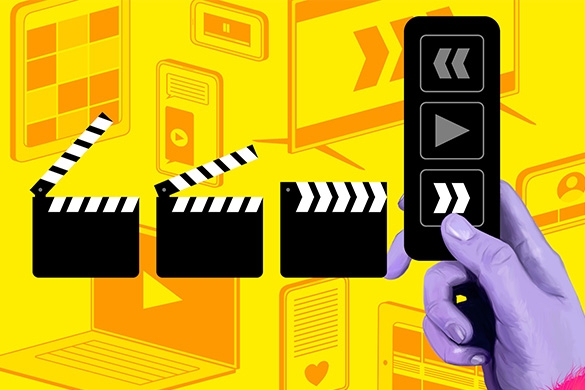
Cartoons, or really all the content we consume, has moved largely outside of live TV. Even the content shown on TV has left the screen due to the rise of “on-demand” platforms. Now, you can watch whatever you want whenever you want without waiting for the next episode. Sometimes, the platform will even play the next episode automatically if you wait a few seconds, without you needing to press a button!
How could our way of consuming content change so much in such a short time? And what effect does this have on society?
THE BINGE-WATCHING CULTURE
Platforms like Netflix, HBO Max, Disney+, Movistar+, Amazon Prime Video, Filmin, and YouTube have completely transformed the way we consume content. According to CNMC, in 2023, 58.1% of households across Spain had access to at least one streaming platform. In the Basque Country, according to IkusIker (2022), Netflix is the most widely used platform, with eight out of ten respondents (83%) reporting access to it, followed by Amazon Prime Video at 53.3%.
Binge-watching culture, however, is not new; it has been around for quite some time. Oxford Dictionaries accepted the term in 2013, defining it as “the practice of watching multiple episodes of a television program in one sitting, typically by means of DVDs or digital streaming”.
WorldMetric (2024) shared some insights on this phenomenon after digging deeply into it. Here are a few findings:
- Each viewer who sits down to watch a series watches an average of 7 consecutive episodes.
- This phenomenon is much more common among younger people, with 90% of millennials and Gen Zers regularly practicing binge-watching.
- 75% of people prefer watching an entire series at once rather than waiting a week for a new episode.
- The “binge-racer” culture has grown, where people try to finish newly released episodes quickly to say they were the first to watch them.
Netflix popularized this practice, and although it has been successful for the company, it has sparked debate among viewers. Medium says that in the long run, binge-watching does not satisfy viewers. Those who wait a bit longer to watch episodes tend to retain more information and give, on average, a more positive rating. Also, cliffhangers and dramatic moments don’t have the same impact when watching the series all at once, which diminishes the enjoyment of the content..
This phenomenon is also linked to mental health. Watching series this way can become addictive, as it causes drastic mood swings. It can also lead to insomnia, feelings of isolation, and emptiness after watching something that elicited strong emotions. Who knew that all that glitters isn’t gold?
SON GOKU EUSKALTZAIN
Another issue posed by streaming platforms and online content is the limited use and visibility of Basque. While these platforms may have a few movies or series in Basque, the catalog is very sparse compared to what Euskal Telebista offers. According to the previously mentioned IkusIker (2022) report, 67.7% of content consumed on these platforms is in Spanish, 26.5% in English, and only 0.7% in Basque.
For minority languages, audiovisual content consumption is crucial. Idoia Alberdi (EITB Media, 2022) points out, “The new audiovisual consumption models are directly impacting the linguistic habits of young people, and this is leading to setbacks in the use of Basque. By far, most of the content consumed is in Spanish. We need Basque-speaking creators and influencers on social media, in gaming, and on all digital platforms. When quality content is available, it is consumed in Basque. The EITB series Go!azen is a prime example. Given this scenario, a firm commitment to Basque-language content in the audiovisual sector is urgently needed, with EITB playing a significant role, alongside RTVE”.
The association Tinko Euskara is working hard to change this. Created in 1994, this organization tirelessly strives to get popular titles translated into Basque and shown on the big screen. They also work to bring Basque-language content to schools so that it can be used as educational material, aiming to increase Basque use among young people.
Pr1meran is another platform created to boost Basque-language content and content produced in the Basque Country (although some of it may not be in Basque). Unlike the platforms mentioned earlier, Pr1meran is free. So if you feel like spending the evening eating popcorn and watching Doraemon, now you know where to go!
9 P.M. HERE OR IN IDAHO?
How we discuss the shows we’ve watched has also changed dramatically in recent years. With such a huge catalog, how can I keep up with what my friends are watching? Also, even if we’re watching the same series, we may be at different points in the story…
No problem, that’s what social media is for! There’s nothing like finishing an episode, opening Twitter (X), and seeing it trending. Memes, theories, thoughts, opinions, Easter eggs you missed… you get it all. Your Instagram and TikTok feeds are also full of content, where you can read others’ thoughts and share your own.
In addition to social media, there are apps created specifically for content consumers. TV Time is one; initially launched in 2011 for tracking and discussing series, it now also lets you track movies. It helps you keep track of what episode you’re on, so you don’t get lost. You can also leave comments on episodes, like others’ thoughts, and debate with anyone on the app. You can even see the total time you've spent watching series and movies…
Letterboxd is essentially the same but specializes in movies and miniseries. Created in 2011, it got popular during the COVID-19 pandemic. As of February 2024, there are 12 million users registered. You can mark movies you’ve seen, those you want to watch, and those you’ve liked, and rate each one (up to 5 stars). You can also comment, make lists of any type with movies of your choice, and see what others are watching. They’re the masters of marketing too, with many Hollywood stars using their platform. Even the famous director Martin Scorsese has his own account!
THE NEVERENDING STORY
One thing’s clear: nothing in life is permanent. Everything we experience changes sooner or later, and how we tell and consume stories is no exception.
In a society where spoilers are the ultimate taboo, wouldn’t it be nice if we could recapture the excitement we felt watching Frieza and Goku’s battle? That way, in the future, we’d remember what we’re watching now with nostalgia and fondness, creating an emotional connection to the content we consume. Isn’t that, in essence, the purpose of storytelling?
One thing’s for sure, though, even if everything else changes, there’s one thing that never will: poor Yamcha’s luck. Hang in there, buddy; everyone’s rooting for you.
Take our advice and check it out
Slide to show more