Enrique Solano, quantum avant-gardist

#Soul tech
11.05.2021
Argitalpen taldea Enrique Solanoren laguntzarekin
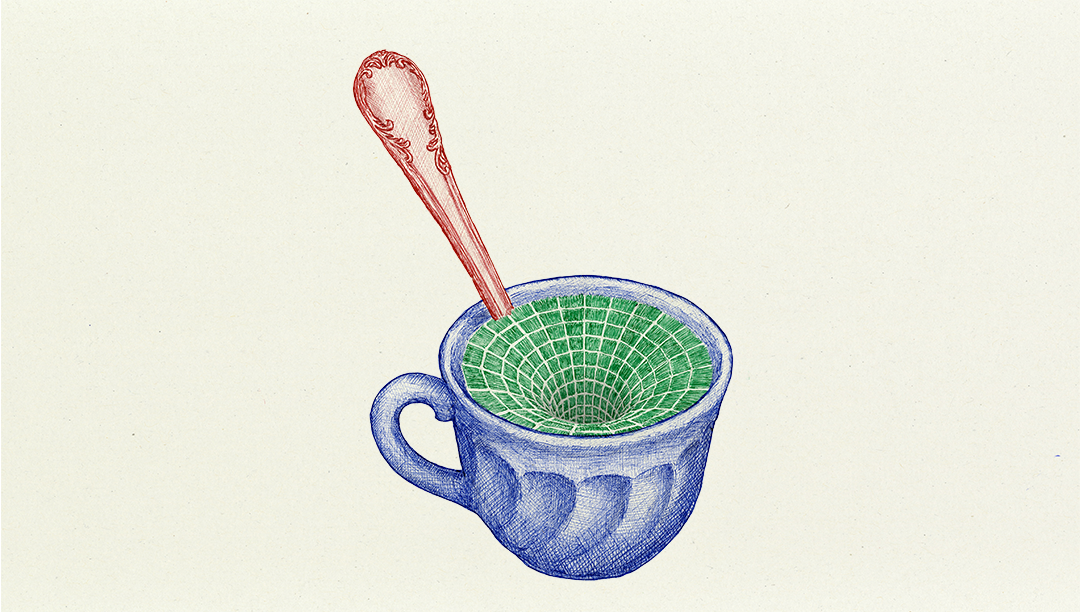

Illustration: Gorka Olmo
Enrique Solano (Lima, 1964) (aka Kike) is truly gifted. Pushing the limits of the laws of quantum physics, Kike seems to be able to be in more than one state and place at the same time.
With a PhD earned in Brazil, he is an Ikerbasque Professor and Director of the ‘Quantum Technologies for Information Sciences’ (QUITS) research group at the UPV/EHU (Bilbao). As an entrepreneur, he is the CEO of Quanvia (Bilbao) and Kipu Quantum (Munich). But, more than quantum entanglement, he is constant work, passion and creativity in its purest form.
His next destination? To dream, and to make it come true in order to radiate out into the world. He is a devout believer in the human capacity to create the seemingly impossible. For him, there are no unsolvable challenges or problems, but rather a lack of time to tackle them.
With a mindset more like that of an artistic polymath from the Renaissance than a scientist or technologist, Kike is in love with the present, with planes, with challenges, – and with the escargot at Pablo Urzay, his favourite pintxo bar, near his old house in Getxo.
With the absolute capacity of someone who has a whole world to discover and a thousand feats to pull off, Kike reveals to us his more artistic side. He teaches us the power of creation, even if it has to involve rowing against the current. A quantum avant-gardist.
We’re talking to the CEO of Quanvia, but, to get to know him better: who is Kike Solano, and where does his interest in technology and quantum physics, in particular, come from?
I’m a geek of the artistic, intellectual, scientific, technological and entrepreneurial worlds. I consider myself an artist, first and foremost. I like to create things that don’t exist, with aesthetic, scientific, and technological criteria…and suddenly I’ve had a very long career in quantum physics, quantum optics, quantum information, quantum computing…
In this creative search for what does not exist, I’ve found that art, science, technology and entrepreneurship go hand in hand. I continue to work as a teacher, as a team director, but somehow I’ve come to believe that it’s time to take the leap into entrepreneurship, so I’m deeply involved in this.
I’ve been creative from an academic point of view, and now it’s time to step into the world of entrepreneurship, because I believe that Quanvia and Kipu Quantum have a new message, a new business model, a new concept and a new technology. And I’m working hard to make it happen.
After all the places you’ve lived, and all your experiences, why did you choose Biscay? What do you think it can offer you that other places can’t?
There’s no right answer to that because it’s kind of visceral. Let’s just say that, wherever I’ve lived, I’ve felt at home. I worked at the Max Planck Institute (Munich), and then at the University of Munich, and they called me and told me that they needed people like me in Bilbao. I’d never been here, so I caught a plane, and they treated me wonderfully. I loved the place. I arrived and I found a beautiful city, the sea, the culture, the history, the Guggenheim…
I really like places where one makes a difference. I like challenges. Bilbao was a challenge for me. There was no culture in quantum computing, there was a tradition in quantum physics, but there was a whole world to create and to discover. And these marvellous people told me: “Kike, do whatever you want, express yourself.”
For me, Bilbao is my life, not only for what it’s given me, but also for what I’ve given it. We’ve worked hard at the Leioa campus, with incredible creative passion, and we’ve made history. We’ve created lines of research, influenced big companies, and kind of set the course for quantum computing worldwide.
The most crucial factor is that everything is yet to be done, and there’s a whole ecosystem that tells you: “Support us, we’ll support you, and here you can make a difference”. Biscay tells you: “We’ll implement the ideas you have here and sell them all over the world”. In Germany it’s almost impossible to turn a screw. I like to contribute when things start to work and where you can make a creative difference.
Quanvia is a spin-off of the UPV/EHU, and you told us that you’re also with Kipu Quantum. Tell us a bit more about what Quanvia is (so everyone can understand it). How is it making a difference?
It’s a start-up, a spin-off born of the UPV/EHU, because Quanvia’s main ideas, in terms of business, arise from extensive research work that we did at the University over 13 years, and I’m not alone. I’m the CEO, but there is a large group of researchers, students and teachers, who, on their own, or with us, have developed basic concepts.
Quantum computing, the scientific part, is very much linked to the technological part, the business part. It’s impossible to detach oneself from this three-way relationship.
Then there is the Quanvia project which, in a way, I launched as an intellectual, technological and entrepreneurial rebellion. I don’t believe in the scientific, technological and business models of quantum computing there are worldwide. I think there’s a lot of hype, an exaggeration of the usefulness of real quantum computing. Quanvia has been created under the “Anti-hype” concept. Another peculiarity is that we never use the word “future”. I’ve never known the future, and I don’t know what people mean..
In business terms, it emerges as a proposal for quantum computing solutions, neither the customer nor society is fooled. Rather, we offer products and services that solve the specific needs of our customers, without them having to wait 100 years to see their utility.
Quantum computing is undergoing a very special moment in history, in which all the variables are aligned. I believe there’s a lack of more responsible companies applying quantum computing to the real needs of society and customers.
We have a way of doing things and looking at quantum computing that is more practical, more focused on usefulness, and, as we’ve developed it ourselves, and some of our competitors are choosing the long road of exaggeration and hype, we decided to create Quanvia to say: “No, this can be useful now” (when I say “now”, I mean in 3-4 years).
We have proposals for algorithmic solutions, for both models and architectures, consultancy solutions, that are much more realistic. And also adapted to what Biscay can offer. In other words, we created Quanvia with a strategy where we don’t kneel before those who have the technological power, and we’re telling them to their faces: “We know how to do it better than you, and we’re going to do it from home, and we’re going to compete and win the markets”.
Biscay’s where we’ve been told: “We’re interested in everything: consulting, algorithms, even the more technological part. We’re already in talks with technology companies to open doors for us, and they’re considering the development of this technology”.
While this is Quanvia’s proposal, how does Kipu Quantum differ?
Although the partners are different, Kipu Quantum aims to be the technology wing. Kipu is bringing the iPhone moment to quantum computing. In other words, it’s the first company worldwide to design and manufacture quantum computers in terms of products.
The supply side of quantum computing, at the technological level, is divided, in the sense that X qubits are made, but then 100 million are needed, and we’re a long way from that. In contrast, Kipu Quantum asks: what application do you need
Kipu Quantum understands the need: financial models, Artificial Intelligence, designing molecules, fluid mechanics… for each need we solve the technological problem in a compact way. The technical term is called “Full Stack”. We attack the specific problem, instead of going general and making and designing quantum computers, as if going from 100 qubits to 100 million - which is when their usefulness will be seen - were a simple thing.
It’s the first company worldwide that makes neither algorithms nor qubits, but a product. The iPhone of quantum computing. In short, Kipu Quantum is the first company to design and manufacture products that contain quantum computers as a component.

"We don't do things for the future; with the technology that exists today, we have designed and are going to manufacture products."
What do you have in the pipeline?
Kipu is a “full stack” product company. Tangible things. Quanvia, meanwhile, is the consultancy, training, sales and image wing. Whatever Quanvia achieves, it will always be supported by Kipu, as a strategic technological partner.
To give you an example: we’re going to talk to the Art Department at the University of the Basque Country and we’re going to ask them: “Why aren’t you pioneers in creating a Quantum Art specialisation?” It turns out that we’ve been able to make 5 qubits, which is not difficult, or buy a small chip and design this. And suddenly we become exporters of quantum computing technology applied to Art. These types of investments then generate profits because you become an exporter.
We also want to run a pilot programme for education on quantum computing in schools, with children ages 5 to 10. I can tell you that when I’ve gone to schools in Bilbao, the children understand it perfectly. At Quanvia we’re going to expose people to these pilot programmes, to democratise quantum computing.
"We want to democratize quantum computing. To me, it seems that elitism in the hands of three multinational corporations is not just incorrect, it's unnecessary. Quantum physics belongs to all human beings. And to young people and children in particular"
What are the main challenges you face?
I use the word “rebellion” frequently because the challenge is huge. Big multinationals are generating dependency in clients, so we come with a mindset of artistic rebellion. Knowing that we have ideas that work, that have been verified and are being used as a new business model. We’re committed to it, but we face the resistance of our competitors.
Practically my whole career has been like this; whenever I’ve been told that one of my ideas wouldn’t work, we worked to prove them wrong.
Difficulty should be used as an advantage. In this case, Quanvia and Kipu Quantum are orthogonal to the mainstream, but they’re not based on dreams, but rather on very influential and well-established work at a global level. And, since no one is following, it’s time to step forward.
"The challenges are tough, but Bizkaia is opening doors for us. We can take advantage of the entire ecosystem they are creating."
What would you say to a 15–18-year-old who doesn’t quite know what they want?
When someone tells you that you’re the future of society, rebel. That’s an insult. You’re the present. Every human being deserves respect for their present. We all have a present that is wonderful. Don’t believe in that language. Their present has worth, they’re important for the present.
We found this chat really interesting, Kike. I don’t know if you’d like to comment on anything or add any further thoughts to the interview.
I want to stress that everything that is being done has a purpose. No one knows what will come out of everything that can be calculated and computed with a quantum computer.
There is a boundless world of human knowledge that eludes us only because of technological complexity. For me, it’s a wonderful challenge to push a little more on the door of that infinite library of knowledge to which we do not yet have access. This library comes from the microscopic world, from atoms, from the minuscule. This is not done for the sake of it, but rather because there’s a whole world of inaccessible knowledge just waiting to be discovered.
Take a look


Take our advice and check it out
Slide to show more