Digitalization vs accesibility: an (im)possible balance

#Soul tech
10.13.2023 Reading time: 8 minutes
Itziar Kerexeta
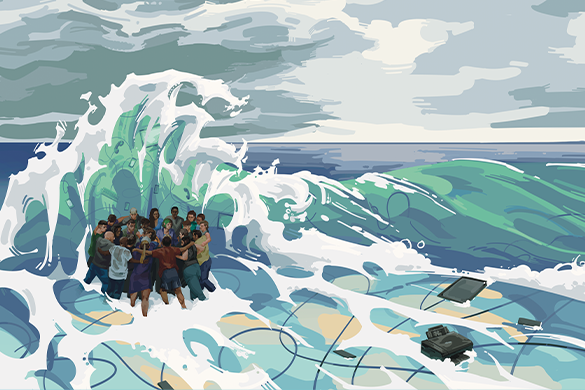
Ilustration: Iker Orueta
That we, as people, are diverse is something we increasingly understand. Fortunately, as a society, we are evolving towards accepting that diversity can be not only good but even desirable.
That we, as people, are diverse is something we increasingly understand. Fortunately, as a society, we are evolving towards accepting that diversity can be not only good but even desirable.
Recent academic studies conducted in the formal education system have shown that the adaptations schools make to better cater to students with functional diversity are also beneficial for the rest of the class, the school, and the community. It's not just about sharing spaces but about full participation.
Now, diving into the topic of digitization, it's widely acknowledged that we live in a hyper-connected society through digital networks that demand competencies to interact with government, banking, friends, colleagues, and even neighbors.
Levels of participation and communication will always vary, but we should aim for a digital citizenship that allows us to exercise our right to participate and engage in society, as defined by the European Union (EU):
Digital competence involves the safe, critical, and responsible use of digital technologies for learning, at work, and for participating in society, as well as interacting with these.

Digital competence involves the safe, critical, and responsible use of digital technologies for learning, at work, and for participating in society, as well as interacting with these.
RIGHT TO DIGITAL LIFE
The commitment to transformation in this direction is evident. We're in the digital decade, and access to technology and acquiring digital skills are part of the ensemble of social rights for citizens established by the EU. Internet was also recognized as a human right by the United Nations back in 2016.
However, aspirations and reality don't always align. The complexity of systems means that people in vulnerable situations, such as seniors or those with functional diversity, face a situation of double exclusion, as Clara Centeno points out in the digital rights forum. The impact of the digital divide is clear: not having access to the internet is a new form of exclusion, and lacking digital skills puts people in a more vulnerable position.
And in this rapid digitalization tsunami, it seems that almost no one is safe. A typical university student faces difficulties installing and using their digital signature, a requirement for enrollment, receiving notifications, processing scholarships... Is the problem in the lack of skills of these young individuals? Or in the complexity of the processes? Certainly, adjustments must be made in both areas, but what is evident is that digitalization brings many adaptation challenges for the general population and even more serious challenges for people in vulnerable situations and/or with functional diversity.
LEARNING THAT INCLUDES EVERYONE
In this regard, ONCE has always been a pioneer in its adaptations for people with reduced vision, making a clear commitment to accessibility. Their audiovisual products enable learning Braille for people with or without reduced vision. Because we all benefit when we learn to communicate in diverse ways, embracing multiple literacies, divergent formats, and based on the principles of universal design for learning. This approach assumes that everyone, regardless of their condition, can access certain resources indispensable for their full participation in society, with or without support. If technology allows us to break the barriers of space and time, enabling us to communicate and work with the other side of the world, something unimaginable a couple of decades ago, what prevents digital procedures from being more accessible to citizens?
In this regard, for example, Gizatea, the social inclusion network of companies in the Basque Country, has done very interesting work on defining digital professional profiles and the necessary training for target professions or those with higher employability in these companies. Individuals responsible for distribution, hospitality, and cleaning, among others, handle fundamental digital devices for the control and monitoring of their work, so they must be trained for this to facilitate their job placement. The network has made this guide available to its associated companies, allowing them to adjust the necessary skills for these positions.
There is also talk about the need to create new professional profiles to support the digitalization processes. Several municipalities in Biscay have deployed citizen support services in this regard, known as "Digital Help Point." The key is, once again, accessibility: if the process is complex, we accompany you. Don't miss out on requesting a certificate of residence, your work history, or signing up for classes at the sports center. The results are positive, it's clear that the digital divide is decreasing, and citizens appreciate these services. But… what if we design from the beginning an Internet and a procedure for everyone?
In this direction, Pratyusha Kalluri, an artificial intelligence researcher at Stanford University, is clear. Let's opt for a more inclusive digitalization model, which will only be possible if people in positions of power and decision-making also include those in vulnerable situations, contributing their ways of interacting and understanding. Because everyone can connect digitally, even if in different ways. And those who know it best are the protagonists.
Take our advice and check it out
Slide to show more