Digital divides
#Soul tech
03.08.2023
BizkaiaTech editorial team
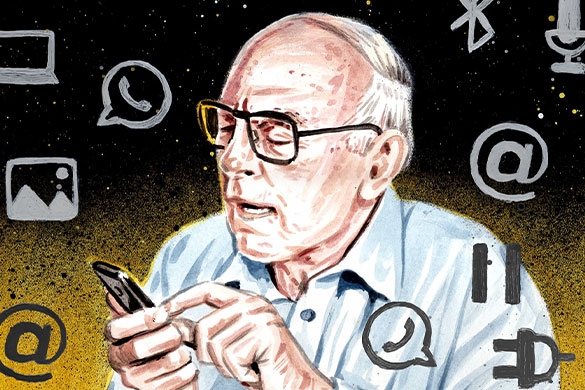
Illustration: Pablo Gallo
How we’ve sped up digitalisation in the last two years is like something out of a sci-fi movie. It no longer surprises anyone that the digital/physical barrier has completely blurred, and we’re oscillating between the online world and the “real” one almost without even realising it.
THE OTHER SIDE OF CONVENIENCE
What would happen if all of our digital devices suddenly stopped working? Would we be able to go back to paper road maps to get home from unknown places? Would we look up everything that we normally search for on Google in encyclopaedias? Going back to the analogue way of doing everything that we used to do so easily with our devices would take us a lot of time, and would be frustrating – not to mention the fact that we surely wouldn’t understand the reason for this change.
Well, that’s a little like the reality that thousands of people have been facing for years, one sped up by the pandemic, producing a sense of indignation and exclusion over a sudden shift that has made them change how they interact with technology. Everything shifted overnight. Suddenly everything was “100% online” – as if this were an advantage! Online banking, online healthcare, online roadside assistance, and much more.
Devices and applications that, for those of us who have grown up with them, seem helpful, practical, and easy to use. Thanks to technology, we can see the faces of our relatives whenever we want, and we no longer have to wait for a letter to arrive, and get news 4 days late (although this was much more exciting). We can work for a company in New York, but live in Lanestosa. And we can choose where to live, a luxury that should be within everyone’s reach.
ONE STEP FORWARD... THREE STEPS BACK?
When our life began to no longer know barriers between the online world and the physical one, and Augmented Reality started its boom, who among us didn’t hunt Pokemons along the river? Then, when the fad had blown over, and we’d gotten used to living with Augmented Reality, the Metaverse appeared, a new concept that promises to be the next generation of the Internet, an immersive and multi-sensory experience through technological devices and developments.
It’s something that we’ll get used to quickly and that we’ll welcome as just one more type of experience in our lives (if we’ve not already done so). Not all that glitters is gold, however. We run a major risk of further broadening the digital divide. If we don’t do things right, the unifying potential of the Metaverse, where one can interact with whomever they want, could become the next nightmare for those who don’t have access to the necessary technology or knowledge to use it.
PUTTING YOURSELF IN OTHERS’ SHOES
For those of us who already have a certain level of technological literacy, and who flirt with new technologies almost by default, it’s easy to understand how these technologies work and to take advantage of them, but we’ve to get our heads out of the sand. After all, there are many people for whom new technology requires a huge effort if it’s not designed to be accessible. “I’m older, not an idiot” is a movement spearheaded by Carlos San Juan de Laorden that collected more than 350,000 signatures on the Change.org platform, and sparked a debate on the closure of bank branches. Despite its emphasis on banking, the movement encompasses all areas that are being digitalised and, as a result, ceasing to offer “real-life” analogue alternatives to online/technological variants. These are movements that are a slap in the face for those of us (myself included) who work with these matters. Our much-touted digitalisation doesn’t address other types of needs; in this case, those of the elderly... but their same problems can be extrapolated to many others who are being left out in the cold.
This divide, which we sometimes see as generational, and almost a side effect of “new things” supplanting “old things”, is also a social divide. If I don’t have access to a computer and I can’t afford the Internet every month, I can’t connect to my online classes... and if I can’t connect to my online classes, I may lose my scholarship. This is a big snowball that is engulfing many – and this is just one example.
For those of us who work in an office with a computer as a basic tool, it’s difficult for us to appreciate the importance of access to technology. It’s easy to think that the divide is narrow, a mere crack that has no consequences, and that every family surely has one or two computers, a tablet, and a high-speed Internet connection (due to our habit of projecting our limited realities outwards). The pandemic, however, has taught us how much remains to be done so that we all have access to technological devices and the Internet all across the region.
CLOSING THE DIVIDE AND BLAZING NEW TRAILS
We’re advancing to close the divide and blaze new trails. We’re doing so slowly but surely, which is how most new trails are blazed. All of the region’s areas, especially the most rural corners, will benefit from a 10-million-euro investment to promote the expansion of the latest generation of the Internet. For the Government of Biscay, it’s important to guarantee this type of infrastructure so that everyone has the same access opportunities.
Effort, planning, and investment are needed to close the divide; there are still many people who want to (and should) be able to stay in their villages and at their local businesses. Just as we have public access to healthcare and education, the Internet and technology are becoming essential if we don’t want to be left behind. Thus, it’s important (and urgent) for everyone who is interested to be able to be connected.
We must be able to create accessible digital experiences using adapted and secure devices. If older people are just learning to use tablets to make videocalls to their loved ones, how can we not be capable of designing digital experiences based on the fundamental principles of accessibility and inclusion? At the same time, we must teach them to interact with technology in a secure way in order to avoid possible privacy concerns, technological attacks, and/or online theft.
EXPLORING WITH PEOPLE AND THE PLANET IN MIND
The future is yet to be written, and we’ll be able to develop everything that we’re capable of imagining now. We have to try to design a future in which the old channels that we’re used to and the new ones that are just emerging complement each other, so as to provide the best possible experience for each moment and the person. What if the same TV on which our amona (Basque for “granny”) watches westerns could also be used to FaceTime with bank staff? Or maybe her adapted mobile could have a button to call for medical assistance. We would achieve a dual benefit: first, these people wouldn’t have such a hard time getting used to new features, because they’d know how the basic device works. Second, we’d reuse devices and avoid generating more electronic waste, which is harmful to the planet, and we can minimise if we act with a mindset geared towards sustainability.
We must have a critical and inclusive perspective. If you don’t adopt something new, sometimes it’s not because you just don’t want to, or because you think “the past was always better”. In fact, that isn’t the case. As William Gibson said, “The future is already here – it’s just not very evenly distributed”. Sometimes we’re simply left sitting on the sidelines and can’t figure out how to get even a minute on the field. Time doesn’t stop, but sometimes it should in order to help all these people who aren’t quite up to speed.
Labels
- #colaboración
- #computación
- #democratización
Take our advice and check it out
Slide to show more
Cookies
We use proprietary and third-party cookies for technical, analytical and customisation purposes, such as choosing the language in which to display the website. For more information, please consult our cookies policy (Opens modal window).
Cookies policy
The website at https://www.bizkaia.eus (hereinafter, the Website) uses tools to track browsing activity on the website and the IP address of the service recipient for the purpose of improving and guaranteeing the provision of services or technical operation of the website, distinguishing you from other users and analysing your browsing habits.
This Cookies Policy seeks to inform you clearly and precisely about the operation and function of the cookies we use.
What are cookies and why do we use them?
A cookie is a file that is downloaded to your computer when accessing certain websites.
Cookies enable a website to, among other things, store and recover information about the browsing habits of a user or their device and, depending on the information contained and the way in which the same is used by the device, may be used to recognise the user.
Current law allows us to store cookies on your device if they are strictly necessary for operation of this website. However, we need permission for all other cookies.
Types of cookies based on the managing entity
Depending on who manages the computer or domain from where the cookies are sent and who processes the data obtained, a distinction can be made between the following types of cookies:
- Proprietary cookies: these are managed by the Provincial Council of Biscay.
-
Third-party cookies: these are managed by another entity, which processes the data obtained via the cookies.
This website may contain cookies belonging to the Basque Government, used for its own purposes and stored by domains other than those owned by the Bizkaia Provincial Council.
Types of cookies based on their purpose
- Technical cookies: these allow the user to browse a website, platform or application and to use the various options or services available, such as control data traffic and communication, identify the session, access restricted areas, request registration or participation in an event, use security elements while browsing, store content for video or audio playback, or share content via social media networks.
- Customisation cookies: these allow the user to access the service with some general characteristics predefined according to a series of criteria on the user’s device, such as the language, type of browser being used to access the service, regional configuration from where the service is accessed, etc.
- Analysis cookies: these allow the number of users to be counted and the browsing activity to be statistically measured and analysed for the purpose of improving the services made available. They may be proprietary or third-party cookies.
Duration of the cookies
- Session cookies: these collect and store data while the user is visiting a website.
- Persistent cookies: the data are stored on the device in an ongoing fashion and may be accessed and processed during a period defined by the cookie manager, which may range from a few minutes to several years.
Which cookies does this website use?
In each row you can find data relating to Technical cookies
| Name | Purpose | Duration | Owner |
|---|---|---|---|
| JSESSIONID | Session identifier | Session | Bizkaia Provincial Council |
| ASPSESSIONID | Session identifier | Session | Bizkaia Provincial Council |
| TS01 | Session identifier | Session | Bizkaia Provincial Council |
| LFR_SESSION_STATE | Session identifier | Session | Bizkaia Provincial Council |
| COOKIE_SUPPORT | Indicate whether the user has the cookie support activated | 1 year | Bizkaia Provincial Council |
| pc_tecnicas_bizkaia | Choose your preferences for acceptance of the block of technical cookies | 1 year | Bizkaia Provincial Council |
| pc_analitica_bizkaia | Choose your preferences for acceptance of the block of analytical cookies | 1 year | Bizkaia Provincial Council |
| pc_preferencias_bizkaia | Choose your preferences for acceptance/rejection of the block of preferential cookies | 1 year | Bizkaia Provincial Council |
| pc_terceros_bizkaia | Choose your preferences for acceptance/rejection of the block of third-party cookies | 1 year | Bizkaia Provincial Council |
| Kultursistema_session | Keeping the user’s session | 1 year | Kultursistema |
| CPLB | Contains information used by our load-balancing servers | Session | Provincial Council of Biscay |
| XSRF-TOKEN | To prevent CSRF (Cross-Site Request Forgery) attacks | 1 year | Kultursistema |
| _GRECAPTCHA | Protects the website from spam and brute-force attacks | 5 months |
In each row you can find data relating to Analysis cookies
| Name | Purpose | Duration | Owner | |
|---|---|---|---|---|
| dtCookie | Track a visit through multiple requests | Session | Bizkaia Provincial Council | |
| dtLatC | Measure the latency of the server to monitor performance | Session | Bizkaia Provincial Council | |
| dtPC | Necessary to identify the appropriate parameters for beacon transmission; includes session ID for correlation | Session | Bizkaia Provincial Council | |
| dtSa | Intermediate storage for actions spanning pages | Session | Bizkaia Provincial Council | |
| rxVisitor | Visitor ID to correlate sessions | Constantly | Bizkaia Provincial Council | |
| rxvt | Session waiting time | Session | Bizkaia Provincial Council | |
| iyrc-user-id | Distinguish users | 1 year | Bizkaia Provincial Council | |
| _ga, _ga_XXXXXXXXXXX | Analysis | To distinguish users | 2 years | Google Analytics |
| _gat, _gat_XXXXXXXXXXX | Analysis | To limit the percentage of requests | 1 minute | Google Analytics |
| _gid | Analysis | To distinguish users | 1 day | Google Analytics |
In each row you can find data relating to Personalisation cookies
| Name | Purpose | Duration | Owner |
|---|---|---|---|
| Idioma | Select the language preferred by the user | 1 year | Bizkaia Provincial Council |
| cookie-tramites-favs | Save favourite procedures in Prior Appointment | 1 year | Bizkaia Provincial Council |
In each row you can find data relating to Third-party cookies
| Name | Purpose | Duration | Owner |
|---|---|---|---|
| CLID | Identify a user’s first visit | 1 year | Microsoft Clarity |
| APISID | Store user preferences and information during page views with Google maps in them. | 2 years | |
| HSID | Store user preferences and information during page views with Google maps in them. | 2 years | |
| MUID | Store user preferences and information during page views with Google maps in them. | 1 year | Microsoft Clarity |
| NID | Remember their preferences and other information | 6 months | |
| SAPISID | Show personalised advertisements on Google sites | 2 years | |
| SID | Provide advertisement delivery or retargeting, provide fraud prevention. | 2 years | |
| SIDCC | Provide reliable web traffic identification. | 1 year | |
| SM | Used to synchronise the MUID between Microsoft domains. | Session | Microsoft Clarity |
| SSID | Provide advertisement delivery or retargeting, provide fraud prevention. | 2 years | |
| __Secure-1PAPISID | Create a website visitor interest profile to show relevant and personalised Google advertising. | 2 years | |
| __Secure-1PSID | Create a website visitor interest profile to show relevant and personalised Google advertising. | 2 years | |
| __Secure-1PSIDCC | Create a website visitor interest profile to show relevant and personalised advertising through retargeting. | 1 year | |
| __Secure-1PSIDTS | Create a website visitor interest profile to show relevant and personalised advertising through retargeting. | 1 year | |
| __Secure-3PSID | 2 years | ||
| __Secure-3PSIDCC | Create a website visitor interest profile to show relevant and personalised advertising through retargeting. | 1 year | |
| __Secure-3PSIDTS | Create a website visitor interest profile to show relevant and personalised advertising through retargeting. | 1 year | |
| __Secure-ENID | Necessary cookies to use website services and options | 1 year | |
| ar_debug | Refine advertisements. | 1 año | |
| MR | Indicate when MUID is refreshed | 6 months | Microsoft Clarity |
| XSRF-TOKEN | Indicate when MUID is refreshed | 1 hour | Kultursistema |
| _fbp | Store and track website visits | 1 year | |
| kultursistema_session | Keep the user’s session | 1 hour | Kultursistema |
| AEC | Detect spam, fraud, and abuse | 6 months | |
| SOCS | Store user cookies preferences | 13 months | |
| Locale | not available | Basque government | |
| _hegoa_coop_session | Create a session ID for users | Session | Basque government |
How to deactivate or delete cookies?
When first accessing the Website, the user may configure and accept or reject the cookies on this Website. Subsequently, the user may change or withdraw their consent at any time via this Cookies Policy or the settings page.
However, you may exercise your right to freely deactivate them and even delete the cookies on this Website at any time. This is done differently depending on which browser you are using. Here is a quick guide for the most popular browsers.
- Deactivate Cookies in Chrome
- Deactivate Cookies in Explorer
- Deactivate Cookies in Firefox
- Deactivate Cookies in Safari
- Deactivate Cookies in Edge
If you deactivate or delete cookies, certain features of the Website may no longer function correctly.
Changes to the Cookies Policy
The Website reserves the right to change this Cookies Policy under the terms provided for by current legislation. We therefore recommend that you revise this policy each time you access our website to see any changes and read the pertinent information.
Configure cookies
We show you hereinbelow the different categories of cookies that our web page uses. You can personalise your choice by accepting or rejecting these categories through the buttons enabled to that end. For more information, consult our cookies policy (Opens modal window).
-
Technical Always active
These are needed to allow browsing on our website and for basic tasks related to correct website operation.
