Beñat Gaztelurrutia and the Pleasure of Seeing Each Other at the Durangoko Azoka

#Tech bay
12.03.2024 Reading time: 7 minutes
Beñat Gaztelurrutia
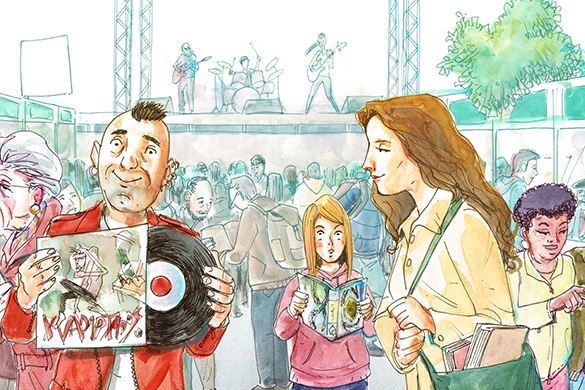
Ilustration: Alberto Muriel
Durango becomes the center of Basque culture throughout the December holiday weekend. This multi-day event, which brings together people of all ages, first opened its doors in 1965 at a porch in Durango, aiming to bring Basque culture (repressed by the dictatorship) closer to its neighbors. Today, despite many social and technological changes, the fair has evolved significantly, but the desire to keep Basque culture alive and thriving remains undiminished.
We talked about these changes with Beñat Gaztelurrutia, the coordinator of Gerediaga Elkartea, the association responsible for organizing Durangoko Azoka. He took the time to help us understand this beloved and important event from the inside. We discussed the beginnings of the fair, the changes it has undergone, new technologies, and its future. Here is what Beñat had to share. Would you like to get to know him better?
BizkaiaTech Magazine: The first Durangoko Azoka was held in 1965 and remains a highly famous and important event to this day. An event that has lasted so many years must learn to absorb and adapt to societal changes (technology, legislation, the Internet, format changes). How do you handle these changes? How has the fair evolved into what it is today?
Beñat Gaztelurrutia: Durangoko Azoka will celebrate its 60th anniversary in 2025, and the changes it has undergone over six decades have been immense. In terms of digitalization, we’ve only seen the revolution it brought in the last two decades, but before that, the fair already had a four-decade trajectory. So, the fair’s evolution can’t be explained by digitalization alone, although it has had the most impact in recent years.
The first fair was put together by setting up some tables under the church. At that time, in 1965, the Basque cultural sector (publishers, record companies, creators, etc.) was completely disorganized. Consequently, to organize the first fair, they had to travel all over the Basque Country to convince people to come. That’s where the journey of Durangoko Azoka begins.
Although we can’t highlight every year, I would say there are two key milestones in the fair’s journey. The first is the starting point we’ve just discussed: this project was created in a very disorganized time. It was an effort to unite the cultural sector, a demand for unity. Later, the sector began to organize itself, with organizations shaping public policies, bookstores opening, and Basque culture passing into the hands of the people. The second major change likely came with digitalization, bringing another milestone, not only in terms of organizing the fair but also in the cultural sector. This shift has also forced a redefinition of the fair itself. Although the organization is constantly evolving, I think these are the two most significant changes. Ultimately, the fair reflects the times we’re in, and the organization must keep up with that.
BTM: Speaking of these changes… How do you assess whether something has worked or not? Is this an all-year-round effort, or do you make decisions after observing people’s reactions? What methodology do you use?
BG: The fair never starts or ends at a specific moment; it’s a wheel that keeps turning. We are constantly in contact with all the people and organizations involved in the fair. These are what we call participants: those who set up the fair, cultural producers, those who help us with presentations, organizations, and sponsors who financially support the event. We are constantly assessing things with all these parts to see what the fair can offer, and we adapt it based on that.
It’s important for me to mention that Gerediaga Elkartea had to initiate this project in a historically significant moment when there was a historical need for education, evening schools (where adults could learn Basque), Euskara batua (unified Basque), and Basque songwriting. While we had to manage the organization and a national project at the time, this doesn’t mean that Gerediaga decides what the fair should be. So far, we’ve created and carried out everything collectively, and we must continue down this path together. The association's role is to gather all the inputs and, in some cases, make decisions, but above all, our main task is to keep our ears open. From the proposals we receive and the evaluations we make, the fair evolves year after year.
BTM: Do you recall a specific year when the fair underwent a drastic change?
BG: Yes, the fair I know best is from recent years, and the change I remember most is the transformation from being just a market to a place where you can have a complete cultural experience. This shift was likely driven by the digitalization we discussed earlier. Today, it has become a place to discover culture, explore it, and attend presentations. It’s not just a one-day plan anymore, it makes you want to come every day. I think that’s the most important change we’ve seen so far.
BTM: You’ve mentioned that digitalization has brought significant changes to the fair, not only in terms of organization but also in how people enjoy it from afar. How has the fair changed since we entered the digital age?
BG: The first thing that changed was the organization: in the beginning, they were only responsible for organizing the fair. In later years, a full catalog was created and published for those who wanted it. Today, in the current Durangoko Azoka, that entire process is done digitally. The entire process with the fair’s participants (name registration, catalog creation, revisions) is also done digitally. We’ve developed a tool to streamline the digitalization process, where anyone who wants to set up a stall can submit their request. Once registered, we ask for everything needed to proceed through the same system, such as what they’ll be selling and a photo. This way, we can show visitors what they can expect. Digitalization has been with us from the start, from contacting the participants to managing relationships with those who will visit the fair. Our way of working has changed a lot.
Digitalization has also impacted the cultural sector, of course. When the digitalization phenomenon first emerged, the initial fear was what would happen to physical books, educational materials (which are also plentiful at the fair), music, audiovisuals, or video games. Each sector has responded differently and had to adapt. For example, it seems that literature has survived and the paper format has persisted, meaning readers still prefer paper over screens. Despite this sector’s resilience, music, for example, hasn’t been able to reinvent itself. Today, all music is free, and I don’t think any band hesitates to put their work online (though they later sold physical copies).
The fair doesn’t have a fixed response; everyone is doing what they can. Additionally, there isn’t a collective effort in the sector to confront this because it’s seen as an international phenomenon, and we’ll just have to get used to it.
Before, you had to come to the fair to access the vast catalog we offered; it was the only way to see the new releases. Today, however, we display all the new arrivals digitally. So, why come to the fair in person? Well, beyond discovering titles and new releases, it allows you to meet the people behind your favorite book or album, talk to them, and hear what they have to say. To have this full experience, it has to be in person. The digital aspect can certainly help the fair, and while we strive to make the most of what it offers, being there physically is more necessary than ever. We want to build a community of people passionate about Basque culture.
BTM: When we talk about digitalization, we can’t ignore another factor that has impacted the entire world in recent years: globalization. We see how culture tends to globalize more and more, and today, Basque culture is no longer just our own. For the fair, would you say this is an advantage or the opposite? How do you think this affects Basque culture?
BG: I would say globalization doesn’t affect Durangoko Azoka much because we are a fair in a very specific place. However, it does affect Basque culture. Personally, I’m quite negative about this topic. It’s true that globalization opens the door to other countries, but it also allows others to enter your home. Opening the doors should be a good thing, but in that journey, minority languages are the ones at risk. This isn’t new, for example, when national markets were created (2-3 centuries ago), it became essential for people to understand each other, so a single language was necessary.
I don’t know what will happen in the future, but globalization must also have its limits. In recent years, we’ve seen that the planet has limits. Only time will tell if, with the depletion of fossil fuels, we will turn to more local economies. Although nothing is certain, in that context, I think smaller languages may have opportunities. In a globalized world, I see more problems than opportunities, although I also believe that Basque culture needs to be open to the world. I think that only enriches us, but the downside is that it could lead to the disappearance of the language.
BTM: To conclude, we’d like to talk about the future of Durangoko Azoka. If technology continues to advance at the rapid pace we’re seeing, societal changes seem more and more inevitable. Artificial intelligence, for example, has gone from being something people hardly talked about to being used daily. Considering this transformation, how do you see Durangoko Azoka in 10 years?
BG: The truth is, it’s hard to imagine. You mentioned artificial intelligence, and I think we’ll need to be very careful with it. Last year, the organization also used AI for our campaign, but we used it as a tool, in an innocuous way. However, it’s true that this tool poses a threat to human creation. There was recently a controversy where an author admitted to creating images and texts using AI, although he later made the corrections himself. I believe authorship needs to be vigilant about this and advocate for human creativity.
I don’t know how much the world will change in a decade, but for now, Durangoko Azoka is a fair of authors and publishers, and everyone involved is very clear on that. I don’t think the fair will be overtaken by these new technologies in the short term.
BTM: Thank you very much for your time, Beñat. If you don’t mind, we’d like to end the interview with your final words.
BG: I’d just like to remind everyone that before the fair opens its doors, we make it available to people using all the tools and possibilities digitalization offers us. However, this digital fair will never replace the experience of attending the fair in person. So… see you at the fair!
Take our advice and check it out
Slide to show more