Age without labels: ageism in institutions, interpersonal interactions and how we see ourselves

-
When
11/12/2026
-
Hour
9:00 - 13:50
Uribe Kosta
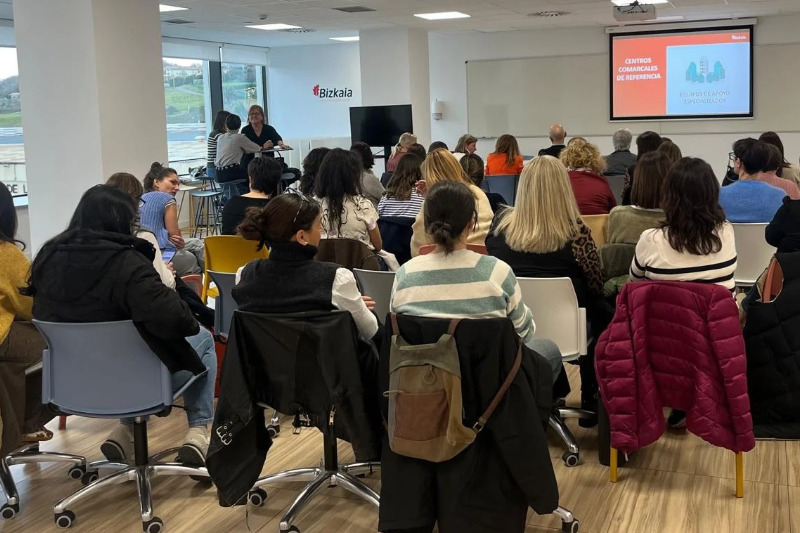
The Directorate-General for Longevity and the Demographic Challenge of the Department of Social Action of the Bizkaia Provincial Council is organising an event on ageism, open both to professionals from different fields and areas of expertise and to the general public. The event will combine the presentation of a detailed report on ageism in Bizkaia with training and participatory activities aimed at understanding, identifying and preventing this form of discrimination.
Ageism is a form of age-based discrimination that is expressed through stereotypes, prejudices and discriminatory practices. It can manifest itself in how institutions operate, in interpersonal relationships and also in the way people themselves perceive their age and their ageing process. Although it can go unnoticed or become normalised, its consequences can affect social participation, well-being, health and the exercise of rights, among other areas of personal and social life.
The event will begin with an introduction to ageism, which will help participants understand what it is, how it works, where it manifests itself and what its main consequences are. Building on this introduction, the findings of a detailed report produced by the NIC as part of the work of the Observatory on Longevity and Long-Term Care (OLC) will be presented. The report combines a conceptual analysis of ageism with data on its prevalence and how it manifests itself in Bizkaia.
One of the most significant findings is that one in five people aged 50 or over has felt discriminated against because of their age (more than 100,000 people in Bizkaia) and that seven in ten believe that older people are not taken into account by society.
Experts will then analyse how ageism operates at three levels: institutional, interpersonal and internalised, and reflect on its implications for individuals and for society. The discussion will then move on to a second, more practical and participatory session, aimed at identifying ageism in specific situations and exploring ways to prevent it.
Through the «Ageist or not?», activity, attendees will be able to test their ability to identify stereotypes, prejudices and discriminatory practices in everyday situations, including those that may seem harmless or well-intentioned. This initial exercise will be followed by a workshop organised around tables of six to eight participants from a range of backgrounds.
Based on case studies inspired by real-life situations, the groups will analyse how ageism operates, what consequences it has and the factors that contribute to perpetuating it. The aim will be to move from recognising ageism to identifying practical measures to prevent and combat it in different areas of social life.
The event will conclude by linking the reflections and proposals arising from the workshop with strategies and measures supported by international evidence to reduce ageism and move towards a more inclusive society that respects people of all ages.
Programme
You can access the programme via the following link.
Details: Age without labels: ageism in institutions, interpersonal interactions and how we see ourselves
Information
Schedule
- 09:00-09:15 WELCOME.
Naiara Artaza, NIC
- 09:15-09:40 Keynote address: Concept, dimensions, levels and main consequences.
VÂNIA DE LA FUENTE-NÚÑEZ (ONLINE)
- 09:40-10:10 Bizkaia in figures. Presentation of the Longevity and Care Observatory monograph: the situation in Bizkaia and key data.
LONGEVITY AND CARE OBSERVATORY AND LONG-TERM CARE (OLC) · SIIS
- 10:10-10:40 COFFE BREAK
- 10:40-11:30 Expert dialogue. How ageism occurs at each level and what can be done about it. Cross‐discusión and questions from the audience.
- Institutional ageism: how a rule, a policy or a service can discriminate by age unintentionally.
ALBERTO INFANTE, HELPAGE ESPAÑA
- Interpersonal ageism: how it shows up in everyday interactions and language.
VÍCTOR CARRAMIÑANA, BBK FUNDAZIOA
- Self‐directed ageism: how stereotypes are internalised and what effects they have.
ELENA DEL BARRIO, MATIA INSTITUTO
MODERATED BY: MARIAN GARRIKABEITIA, SILVER FILM FESTIVAL
- Institutional ageism: how a rule, a policy or a service can discriminate by age unintentionally.
- 11:30-12:00 Interactive activity: Ageist or not? Assessing everyday situations using coloured cards.
AUDIENCE AND PANEL SPEAKERS - DRIVEN BAY: MARIAN GARRIKABEITIA
- 12:00-13:20 Workshop. Identifying ageism in one's own setting. Case analysis in working groups that combine profiles and the formulation of one measure per working group.
DRIVEN BY: SIIS
- 13:20-13:50 What have we learned? Strategies to combat ageism and closing remarks. Group proposals and evidence-based recommendations from the WHO Global Report on Ageism.
SIIS AND GROUP SPOKESPERSONS
Observations
- Capacity: 60 people.
- Languages: Spanish and Basque. The workshop will be held in Spanish.
- Deadline: 11 November 2026
- Who is it aimed at? The event is open to professionals from different fields and areas of expertise, as well as to the general public.
Location
Aita Gotzon Kalea, 37, 48610 Urduliz, Bizkaia. <span lang="es">Planta</span> 4. Aita Gotzon Kalea, 37, 48610 Urduliz, Bizkaia. <span lang="es">Planta</span> 4
-
When
11/12/2026
-
Hour
9:00 - 13:50
And also
-
Uribe Kosta
- Place Aita Gotzon Kalea, 37, 48610 Urduliz, Bizkaia. Planta 4
- Date 20/11/2026
-
Uribe Kosta
- Place Aita Gotzon Kalea, 37, 48610 Urduliz, Bizkaia. Planta 4
- Date 27/10/2026
-
Uribe Kosta
- Place Aita Gotzon Kalea, 37, 48610 Urduliz, Bizkaia. Planta 4
- Date From 22/10/2026 to 23/10/2026