The Pedagogy of Thinking: the pending subject of the education system
#Tech bay
09.29.2025 Reading time: 6 minutes
Miren Munitis
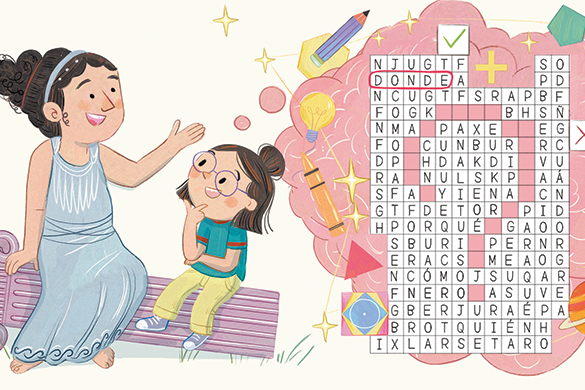
Illustration: Nuria Hache
How many times a day do we use the word think? We talk about thoughts, we use the verb to think as an imperative (especially in teaching), we use it to identify the process of turning things over in our heads… But do we really understand what it means and what it entails? Do we know how to think effectively?
More than 12 years ago, I began exploring thinking, prompted by some questions that kept resonating in my head: What is thinking? How can the capacity to think be broken down? What skills or abilities should we develop to think effectively? What are the consequences of not developing thinking skills? (mental rigidity, impulsive thinking, conformism and intellectual dependence, superficiality, egocentrism, cognitive distortions and biases, or superstitious thinking, among many others). What limiting and/or empowering factors exist in the thinking process? How can we teach thinking?
In my early years as a teacher, I focused my inquiry on the very definition of thinking and the identification of different types of thinking. There are several theories and authors who study this, long lists, differing definitions and classifications. Thanks to this passionate (and endless) exploration, I discovered wonderful programs and educational resources committed to and focused on teaching how to think, such as Philosophy for Children, Project Zero (Harvard), TBL (Thinking Based Learning), Visible Thinking… And authors like Robert J. Swartz, Arthur L. Costa, David Perkins, Rebecca Reagan, Robert H. Ennis, Matthew Lipman, Ann Sharp, Bena Kallick, and Paul Ritchard, among others, became constant references and sources of inspiration in my daily practice.
I trained to become a TBL teacher and coach and also took several courses on Philosophy for children. Although these trainings were highly satisfying and interesting, I still needed a more complete, specific, and precise pedagogical program to teach my students how to think and to provide them with what education should truly offer: a deep, well-structured plan to develop, explicitly and systematically, productive and reflective thinking from an early age.
THE TEACHER AS A MIRROR
As teachers, we ask and demand students to think far more often than we actually teach them to. Every classroom activity requires thinking, but who takes responsibility for teaching them how to think effectively? For teaching them which thinking skill or ability to use in each context? Of course, to avoid teacher hypocrisy, it would be dishonest to teach thinking if we ourselves, as educators, are not fully committed to training and improving our own thinking capacity. We must embody virtues related to thinking dispositions, strategies, and skills. We must explicitly share our thinking processes with students (the strengths and the weaknesses) with the closeness, transparency, and honesty they deserve. We must reflect on our own learning and thinking processes alongside them, becoming a mirror in which they can see themselves reflected. From there, through self-assessment and constant metacognitive reflection (on the effectiveness of our mental processes), we can model and guide our students toward deeper and more effective thinking processes.
To raise awareness among those interested in this field and to share resources and personalized training, my colleague Viridiana Barbán (one of the key references in Thinking-Based Learning, TBL) and I founded OneTwoThink and the framework of the Pedagogy of Thinking. This project was born about six years ago, with the goal of asserting the importance and necessity of teaching and learning to think, to ensure that future generations are not only capable of understanding and consuming knowledge, but above all, of constructing it. And furthermore, that they do so in a committed, collaborative, and responsible way, contributing to the improvement of both the world around them and their own.
THE METHOD
The pedagogy of thinking is grounded in developing thinking dispositions and skills through their direct teaching and their integration into the official curriculum via meaningful and efficient methodological and didactic strategies. By thinking dispositions and skills we mean such abilities as analysis, questioning and critical thinking, creativity, philosophical-scientific inquiry, entrepreneurial thinking, ethics, collaboration, effective communication, and above all, metacognitive reflection. The foundation of pedagogy of thinking is built on three essential pillars: BEING, KNOWING, and KNOWING HOW TO DO.
Over these years, we have trained more than 600 teachers from different countries and created a complete program with specific teaching materials, such as the student book The Adventure of Learning to Think (La aventura de aprender a pensar), the teacher book The Challenge of Teaching to Think (El reto de enseñar a pensar), and a set of card decks designed to train each thinking skill.
We are enormously proud to see how more and more schools are embracing the pedagogy of thinking and implementing the full program in their classrooms, thanks to the teaching resources and training we provide.
GAMIFICATION FOR LEARNING
Students learn to think thanks to eight characters we have designed. In the book, each represents an intellectual disposition and is intended to model and guide awareness and the development of certain tendencies toward effective, reflective, and conscious thinking. Each character is assigned a particular approach, disposition, and defining traits: What represents and stimulates them? What do students connect with? What capacities do they develop?
For example, one of the characters, Sophis, represents philosophical thinking and curiosity. They respond with wonder and interest to the world around us, formulate relevant, creative, and transformative philosophical and scientific questions; they investigate and inquire into different subjects and disciplines, showing openness to new knowledge and lifelong learning.
Another example is Logos, who represents the virtue of logical thinking and has a strong capacity for analysis. They show ambition and precision in seeking information and organizing it in a logical and reasoned way. They pursue deep, conceptual understanding of facts and ideas; and to do so, they identify components, similarities and differences, causes, consequences, patterns, relationships, and implications. They explore multiple perspectives.
Teaching experience over the years shows us how students develop their problem-solving abilities, creativity and divergent thinking, commitment to inquiry and lifelong learning, decision-making, and the depth with which they approach any topic, whether daily or disciplinary. And all of this through collaboration, reflection, and ethical commitment, recognizing that effective thinking must be used to improve the world.
Teaching how to think is not an add-on; it is the very heart of learning. It is not optional; it is a duty. The pedagogy of thinking not only helps develop cognitive skills, but also cultivates curious, ethical, and autonomous minds capable of facing the complexity of the world with judgment, creativity, and responsibility. To commit to it is to commit to a transformative and deeply human education.
This is our way of contributing to the education sector and to the community at large. Who’s in?
Labels
- #emprendimiento
- #estrategia
- #futuro
- #educación
- #talento
Take our advice and check it out
Slide to show more
Cookies
We use proprietary and third-party cookies for technical, analytical and customisation purposes, such as choosing the language in which to display the website. For more information, please consult our cookies policy (Opens modal window).
Cookies policy
The website at https://www.bizkaia.eus (hereinafter, the Website) uses tools to track browsing activity on the website and the IP address of the service recipient for the purpose of improving and guaranteeing the provision of services or technical operation of the website, distinguishing you from other users and analysing your browsing habits.
This Cookies Policy seeks to inform you clearly and precisely about the operation and function of the cookies we use.
What are cookies and why do we use them?
A cookie is a file that is downloaded to your computer when accessing certain websites.
Cookies enable a website to, among other things, store and recover information about the browsing habits of a user or their device and, depending on the information contained and the way in which the same is used by the device, may be used to recognise the user.
Current law allows us to store cookies on your device if they are strictly necessary for operation of this website. However, we need permission for all other cookies.
Types of cookies based on the managing entity
Depending on who manages the computer or domain from where the cookies are sent and who processes the data obtained, a distinction can be made between the following types of cookies:
- Proprietary cookies: these are managed by the Provincial Council of Biscay.
-
Third-party cookies: these are managed by another entity, which processes the data obtained via the cookies.
This website may contain cookies belonging to the Basque Government, used for its own purposes and stored by domains other than those owned by the Bizkaia Provincial Council.
Types of cookies based on their purpose
- Technical cookies: these allow the user to browse a website, platform or application and to use the various options or services available, such as control data traffic and communication, identify the session, access restricted areas, request registration or participation in an event, use security elements while browsing, store content for video or audio playback, or share content via social media networks.
- Customisation cookies: these allow the user to access the service with some general characteristics predefined according to a series of criteria on the user’s device, such as the language, type of browser being used to access the service, regional configuration from where the service is accessed, etc.
- Analysis cookies: these allow the number of users to be counted and the browsing activity to be statistically measured and analysed for the purpose of improving the services made available. They may be proprietary or third-party cookies.
Duration of the cookies
- Session cookies: these collect and store data while the user is visiting a website.
- Persistent cookies: the data are stored on the device in an ongoing fashion and may be accessed and processed during a period defined by the cookie manager, which may range from a few minutes to several years.
Which cookies does this website use?
In each row you can find data relating to Technical cookies
| Name | Purpose | Duration | Owner |
|---|---|---|---|
| JSESSIONID | Session identifier | Session | Bizkaia Provincial Council |
| ASPSESSIONID | Session identifier | Session | Bizkaia Provincial Council |
| TS01 | Session identifier | Session | Bizkaia Provincial Council |
| LFR_SESSION_STATE | Session identifier | Session | Bizkaia Provincial Council |
| COOKIE_SUPPORT | Indicate whether the user has the cookie support activated | 1 year | Bizkaia Provincial Council |
| pc_tecnicas_bizkaia | Choose your preferences for acceptance of the block of technical cookies | 1 year | Bizkaia Provincial Council |
| pc_analitica_bizkaia | Choose your preferences for acceptance of the block of analytical cookies | 1 year | Bizkaia Provincial Council |
| pc_preferencias_bizkaia | Choose your preferences for acceptance/rejection of the block of preferential cookies | 1 year | Bizkaia Provincial Council |
| pc_terceros_bizkaia | Choose your preferences for acceptance/rejection of the block of third-party cookies | 1 year | Bizkaia Provincial Council |
| Kultursistema_session | Keeping the user’s session | 1 year | Kultursistema |
| CPLB | Contains information used by our load-balancing servers | Session | Provincial Council of Biscay |
| XSRF-TOKEN | To prevent CSRF (Cross-Site Request Forgery) attacks | 1 year | Kultursistema |
| _GRECAPTCHA | Protects the website from spam and brute-force attacks | 5 months |
In each row you can find data relating to Analysis cookies
| Name | Purpose | Duration | Owner | |
|---|---|---|---|---|
| dtCookie | Track a visit through multiple requests | Session | Bizkaia Provincial Council | |
| dtLatC | Measure the latency of the server to monitor performance | Session | Bizkaia Provincial Council | |
| dtPC | Necessary to identify the appropriate parameters for beacon transmission; includes session ID for correlation | Session | Bizkaia Provincial Council | |
| dtSa | Intermediate storage for actions spanning pages | Session | Bizkaia Provincial Council | |
| rxVisitor | Visitor ID to correlate sessions | Constantly | Bizkaia Provincial Council | |
| rxvt | Session waiting time | Session | Bizkaia Provincial Council | |
| iyrc-user-id | Distinguish users | 1 year | Bizkaia Provincial Council | |
| _ga, _ga_XXXXXXXXXXX | Analysis | To distinguish users | 2 years | Google Analytics |
| _gat, _gat_XXXXXXXXXXX | Analysis | To limit the percentage of requests | 1 minute | Google Analytics |
| _gid | Analysis | To distinguish users | 1 day | Google Analytics |
In each row you can find data relating to Personalisation cookies
| Name | Purpose | Duration | Owner |
|---|---|---|---|
| Idioma | Select the language preferred by the user | 1 year | Bizkaia Provincial Council |
| cookie-tramites-favs | Save favourite procedures in Prior Appointment | 1 year | Bizkaia Provincial Council |
In each row you can find data relating to Third-party cookies
| Name | Purpose | Duration | Owner |
|---|---|---|---|
| CLID | Identify a user’s first visit | 1 year | Microsoft Clarity |
| APISID | Store user preferences and information during page views with Google maps in them. | 2 years | |
| HSID | Store user preferences and information during page views with Google maps in them. | 2 years | |
| MUID | Store user preferences and information during page views with Google maps in them. | 1 year | Microsoft Clarity |
| NID | Remember their preferences and other information | 6 months | |
| SAPISID | Show personalised advertisements on Google sites | 2 years | |
| SID | Provide advertisement delivery or retargeting, provide fraud prevention. | 2 years | |
| SIDCC | Provide reliable web traffic identification. | 1 year | |
| SM | Used to synchronise the MUID between Microsoft domains. | Session | Microsoft Clarity |
| SSID | Provide advertisement delivery or retargeting, provide fraud prevention. | 2 years | |
| __Secure-1PAPISID | Create a website visitor interest profile to show relevant and personalised Google advertising. | 2 years | |
| __Secure-1PSID | Create a website visitor interest profile to show relevant and personalised Google advertising. | 2 years | |
| __Secure-1PSIDCC | Create a website visitor interest profile to show relevant and personalised advertising through retargeting. | 1 year | |
| __Secure-1PSIDTS | Create a website visitor interest profile to show relevant and personalised advertising through retargeting. | 1 year | |
| __Secure-3PSID | 2 years | ||
| __Secure-3PSIDCC | Create a website visitor interest profile to show relevant and personalised advertising through retargeting. | 1 year | |
| __Secure-3PSIDTS | Create a website visitor interest profile to show relevant and personalised advertising through retargeting. | 1 year | |
| __Secure-ENID | Necessary cookies to use website services and options | 1 year | |
| ar_debug | Refine advertisements. | 1 año | |
| MR | Indicate when MUID is refreshed | 6 months | Microsoft Clarity |
| XSRF-TOKEN | Indicate when MUID is refreshed | 1 hour | Kultursistema |
| _fbp | Store and track website visits | 1 year | |
| kultursistema_session | Keep the user’s session | 1 hour | Kultursistema |
| AEC | Detect spam, fraud, and abuse | 6 months | |
| SOCS | Store user cookies preferences | 13 months | |
| Locale | not available | Basque government | |
| _hegoa_coop_session | Create a session ID for users | Session | Basque government |
How to deactivate or delete cookies?
When first accessing the Website, the user may configure and accept or reject the cookies on this Website. Subsequently, the user may change or withdraw their consent at any time via this Cookies Policy or the settings page.
However, you may exercise your right to freely deactivate them and even delete the cookies on this Website at any time. This is done differently depending on which browser you are using. Here is a quick guide for the most popular browsers.
- Deactivate Cookies in Chrome
- Deactivate Cookies in Explorer
- Deactivate Cookies in Firefox
- Deactivate Cookies in Safari
- Deactivate Cookies in Edge
If you deactivate or delete cookies, certain features of the Website may no longer function correctly.
Changes to the Cookies Policy
The Website reserves the right to change this Cookies Policy under the terms provided for by current legislation. We therefore recommend that you revise this policy each time you access our website to see any changes and read the pertinent information.
Configure cookies
We show you hereinbelow the different categories of cookies that our web page uses. You can personalise your choice by accepting or rejecting these categories through the buttons enabled to that end. For more information, consult our cookies policy (Opens modal window).
-
Technical Always active
These are needed to allow browsing on our website and for basic tasks related to correct website operation.
