The Fediverse and the sustainability of life

#Soul tech
03.24.2025 Reading time: 7 minutes
Diana Franco
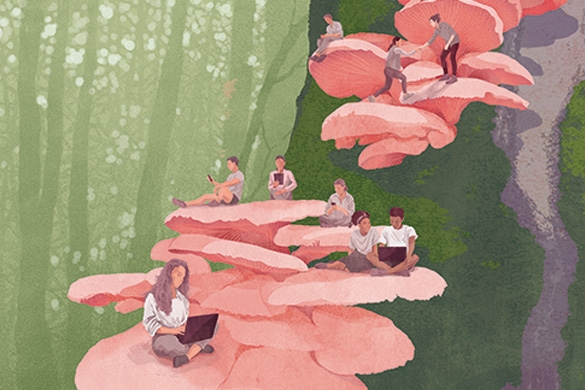
Ilustration: Adara Sánchez
Technology can be developed in many different ways. In relation to this idea, Donna Haraway says something I like to repeat: “We depend on what we make, and we are what we make.” This phrase suggests that the technology we create is a reflection of our society. Therefore, to stop the ecological catastrophe we humans are causing, we should rethink our relationships with the planet and the species that inhabit it. The Fediverse is a practical example of this reconsideration of relationships.
WHAT RELATIONSHIPS DOES THE FEDIVERSE REDEFINE?
The Internet was launched in the 1960s and developed within the framework of economic and political power structures. These structures shaped its evolution, embedding their values into the Internet as we know it today. This is why it is crucial to ask who creates technology and for what purpose. Technology absorbs our character, both its light and dark sides. Ultimately, technology is not neutral. Given this, we must constantly evaluate and rethink the technological models we use.
In today's model, most Internet spaces are owned by a few corporations. The Internet is centralized.
These corporations have designed the infrastructures and business models that dominate the Internet. The expansion of these infrastructures increases their power in society. They compete to maintain and expand this power, driving continuous growth and resource exploitation. However, the world's resources are not unlimited.
The Fediverse proposes a decentralized model that, while not requiring major changes for users, challenges corporate business models. These business models rely on exploiting vast amounts of user data by centralizing computational power and turning it into valuable information. To achieve this, they require massive infrastructure (servers, communication networks, device development, software… in other words, clouds). These centralized clouds have negative effects on human life and the environment.
THE ENVIRONMENTAL IMPACT OF THE CURRENT DIGITALIZATION MODEL
In our daily lives, we use the Internet without limits. Every action we take online, sending a message, watching a movie, making a suggestion, has an energy cost. Given that digitalization is constantly growing, the numbers are concerning:
Internet usage in 2023:
- 66% of the world’s population had Internet access, a 51% increase compared to 2018.
- The average number of devices per person was 3.6 in 2023.
- 50% of connections were M2M (Machine-to-Machine, or Internet of Things, IoT) devices such as cars and smart appliances that connect automatically.
The influence of data centers (the cloud) in the centralized digitalization model:
- In 2022, global data centers consumed as much energy as the entire country of France.
- Most of the electricity required to run every day Internet services (social media, email, streaming platforms…) comes from fossil fuels. About 40% of that energy is used just to cool the infrastructure.
- Large amounts of water are needed to cool servers. The activist group “Tu Nube Seca Mi Río” (Your Cloud Dries My River) has reported the environmental damage caused by Facebook’s data center, built near a river in Talavera de la Reina, Spain.
- Today, the cloud has a larger carbon footprint than the airline industry. A single data center can consume as much electricity as 50,000 homes.
The growing energy demands of our current digitalization model will not stop until energy resources are depleted or until strict regulations are implemented (Low Tech Magazine).
Now, artificial intelligence is adding to these energy demands:
- AI is already integrated into many platforms and websites, analyzing user behavior and running energy-intensive processes.
- Training Meta’s AI model, LLaMA, emits more CO2 than 2,400 cars per year.
- By 2030, 41% of data center electricity consumption will be used for AI.
How can the fediverse help reduce the environmental impact of digitalization?
The Fediverse alone cannot solve this problem. However, in combination with other efforts, it can play a crucial role in rethinking our digital relationships and their impact on the world.
Therefore, on the path toward a more sustainable life on this planet, the Fediverse generates two types of relationships:
- Those related to the power dynamics that exist in society today: empowering more actors and weakening the power of the tech oligopolies that dominate the Internet.
- Those related to human relationships with the environment: the energy needs of small, decentralized infrastructures can be adapted to local capacities and managed more sustainably.
BUT WHAT IS THE FEDIVERSE?
The Fediverse is another way of creating and existing on the Internet. It transforms the way relationships between users and service providers are structured. The Fediverse is a technological model based on the values of distributing power, data sovereignty, and privacy protection.
The Fediverse contains two words: federated and universe. In Biscay, we are very familiar with the first word, federated, as we have many federations in our region: parent associations, various sports clubs, leisure organizations… These associations unite in pursuit of shared goals, gaining greater strength in both society and institutions.
The second word, universe, signifies that in the infrastructures that make up the Fediverse, anyone can be an agent. That is, in this universe, there is no centralized infrastructure as in the current dominant model. Instead, the servers that make up this universe are autonomous. The Fediverse operates across all these servers using Free and Open-Source Software (FLOSS) and spreads through the Internet.
Free Software is software that can be copied, analyzed, modified, and distributed. To be considered Free Software, it must meet four freedoms:
- The freedom to run it for any purpose.
- The freedom to examine and modify it.
- The freedom to copy it.
- The freedom to improve it and make those improvements public for the benefit of the community.
THE FEDIVERSE INFRASCRUCTURE
The Fediverse is not based on centralized infrastructure; it is a decentralized infrastructure.
The Fediverse is built with software that runs within a network using the same communication protocols among independent servers (also known as instances or nodes). Thanks to this software, instances can connect, creating a universe of federated instances, each with its own identity.
Currently, the most widely used communication protocol is Activity Pub, which is used by the following software:
- Mastodon // microblogging // alternative to X and Bluesky.
- Lemmy // forums // alternative to Reddit.
- Signal // messaging // alternative to Whatsapp and Facebook Messenger.
- Peertube // video sharing // alternative to YouTube.
- Pixelfed // photo sharing // alternative to Instagram.
The Basque Fediverse has grown in recent years, creating numerous instances. Informally, euskera has found a thriving space: mastodon.eus, pixelfed.eus, lemmy.eus, peertube.eus…
Furthermore, last January, the Abaraska community, driven by various social groups, launched a worldwide campaign to support individuals and organizations in their transition to the Fediverse.
WHO’S BEHIND THE FEDIVERSE?
A self-organized society. From its inception, the Fediverse has been promoted by Free Software communities. These communities organize themselves both formally and informally. Many developments are initiated by individuals or groups, either independently or as part of work and research projects. These projects are enriched by contributions (knowledge, outreach, funding…). There are also organized entities that support, promote, or spread these developments. In this way, ideas and innovations are gradually integrated into different levels of society.
LET'S JOIN THE PATH THEY HAVE STARTED…
As I said earlier, the Fediverse alone will not change anything—it simply shows a path. We must work together with other movements to influence the digitalization model we have:
- Develop closed energy cycles in server infrastructures designed for local conditions.
- Continue supporting the development of Free Software.
- Protect digital rights.
- Regulate energy usage.
- Combat planned obsolescence to reduce electronic waste.
- Promote education: expand our knowledge of devices and technology.
We have a long journey ahead—full of opportunities.
Take our advice and check it out
Slide to show more