From Network Society to Digital Labyrinth: Algorithms, Bubbles, and Attention Markets

#Soul tech
06.09.2025 Reading time: 9 minutes
Iñigo Galzacorta
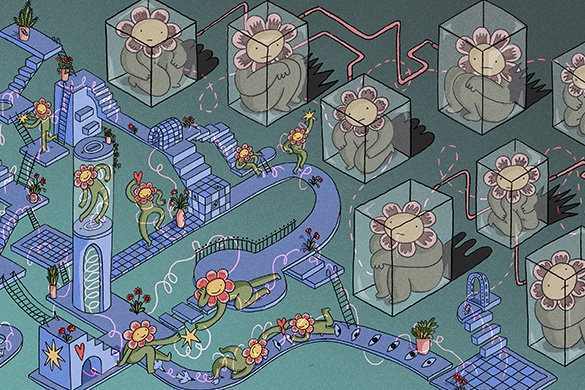
Illustration: Julia Gris
Those of us who were young in the 1990s still remember the enthusiasm with which the arrival of the internet was received. Suddenly, a new space of freedom opened before our eyes, a digital territory where information would flow horizontally and globally, bypassing the mediation and censorship of the powerful groups that at the time controlled the media shaping the public sphere. It was as if, overnight, a crack had appeared in the wall of one-way communication: forums like The Well, homemade pages like Geocities, or collaborative projects like Wikipedia embodied the promise of a “network society,” where knowledge and public discussion could circulate freely and without hierarchy, weaving collaborative networks that would challenge the vertical structures of the past.
Today, three decades later, that crack of hope has turned into a labyrinth whose walls are constantly redesigned by invisible architects. The image of the “network society” no longer evokes a world of freedom and horizontal communication but rather a mesh that entangles us, guiding our interactions, access to information, and even our tastes and desires. The promise of reticular freedom has mutated into an effective regime of surveillance, where sophisticated algorithms, new instruments of control disguised as technical neutrality, decide what we see and what we think, turning the traces of our online lives into the engine of a new global economic model.
TECHNOLOGIES OF RELEVANCE
Establishing a criterion to sort and select information has been a constant challenge throughout the history of civilization. Libraries, catalogs, encyclopedias, as well as various academic and publishing projects, illustrate how each era has faced the growing mismatch between stored information and the human capacity to assimilate it.
1998 was a decisive year in this history. That’s when Google, a company destined to transform the world we had known until then, emerged. At a time when the exponential growth of the World Wide Web was making search engines like Yahoo! or Altavista obsolete — still relying on traditional classification methods — Google’s PageRank algorithm dazzled those of us who were then intuitively navigating a sea of irrelevant links with its simplicity and effectiveness. But Google’s surprise was not only its power to bring order to the chaos the web was becoming. While its rivals overwhelmed our screens with invasive ads, Google offered a clean, minimalist design: a white canvas topped by a simple logo and a search bar. This almost ascetic simplicity was disconcerting: what was the business model behind this seemingly selfless tool? The answer lay in the invisible. We suspected that its control over the information — deciding what we saw in each search — gave it unprecedented power. What we didn’t yet know was that the real treasure wasn’t in the information it offered us — but in the data we were giving it.
GOOGLE AS MODEL: ALGORITHMS AND THE COMMODIFICATION OF ATTENTION
Who could have guessed that behind that clean and seemingly transparent page was the secret machinery of the world to come? Google's power — destined to transform how the web worked — lay in a sinister intersection of two data flows: on the one hand, it offered us order and relevance, selecting the information worth seeing; on the other, it extracted and archived every trace of our digital activity, turning it into a new source of value. This dual movement is the hidden core of life online.
Google taught us the power of the algorithm, a term vaguely remembered by humanities students from math classes but which would become crucial for understanding the society and politics of the years ahead. The PageRank algorithm didn’t just organize chaos on the web, it defined what was worth seeing and what should be buried. By deciding “relevance,” Google became the arbiter of public truth, a role once held by editorial or academic institutions. Unlike those, its criteria were not human or debatable, but a mathematical code presented as neutral and objective. PageRank was just the beginning: soon, algorithms would govern not only our searches but also our social relationships (Facebook), music preferences (Spotify), romantic connections (Tinder), and political opinions (Twitter).
At the same time, the web became a massive data-extraction mechanism. Every search, like, or two-second pause became a valuable commodity in what Shoshana Zuboff has called the “behavioral futures markets.” Platforms like Google or Facebook predict and shape our behavior, selling that information to the highest bidder. This economic model, based on attention as a finite resource, has concentrated talent and resources around a single goal: keeping us glued to our screens. Designers, psychologists, and engineers work to perfect the mechanisms that turn our curiosity into attention. Thus, while we think we freely navigate the web, we are actually feeding the machines that control us. The intersection of these two forces — the power to dictate what information is relevant and the conversion of our digital lives into commodities — has defined the contemporary world.
THE AGE OF PERSONALIZATION: FROM GLOBAL VILLAGE TO DIGITAL TRIBALISM
2009 was another turning point. That year, Google announced a major update to its relevance algorithms. From then on, our browsing data would not only feed the markets where companies and political parties bought predictions about our habits, but also — as they claimed — “improve user experience.” The promise was seductive: results would no longer be universal but personalized. Relevance ceased to be an abstract and general concept and became something individual and tailored to each user. Just like that, the age of personalization began.
Behind this apparent concession was a perfect trap, consolidating the fusion between the two flows: content selection and data extraction were now one and the same. Personalization was not neutral, it prioritized content that maximized screen time, turning “relevance” into a tool of the attention economy. Platforms like YouTube and Facebook perfected the art of “addictive relevance”: algorithms prioritizing content capable of keeping us glued to the screen, even if that meant promoting conspiracy theories, hate speech, or fake news. Truth or public interest were no longer decisive criteria, what was “relevant” was whatever held our attention long enough to generate more data for sale.
We witnessed a redefinition of the public sphere. The global village fragmented into a set of digital tribes. “Filter bubbles” (Eli Pariser) isolated us in parallel realities where facts and fictions competed on equal footing. Google hadn’t solved the problem of relevance; it had privatized it. Polarization is not a side effect, it is the logical result of a system that monetizes attention and relevance.
THE STRUGGLE FOR THE COMMONS IN A DIGITAL WORLD
Our time is marked by a singular situation. We live at the intersection of two profit-extraction modes: the industrial, which leaves a toxic legacy on our planet, and the digital, which undermines our capacity to respond to it. To confront the ecological crisis, we need shared facts, trust in science, and coordinated global action; but 21st-century capitalism turns the public sphere into a fragmented battlefield. Algorithms that govern the web, designed to monetize every second of attention, prioritize outrage over dialogue, the quick click over reflective thought.
Life online is defined by unprecedented asymmetry. The mechanisms behind the screen know nearly everything about our lives, while we know almost nothing about how they function. Digital corporations track our sleep patterns, political fears, and shopping habits, but their algorithms, the rules shaping our online lives, operate in opacity. Disguised as efficient and neutral tools, they are in fact architectures of power that decide what ideas circulate, what voices are amplified or silenced, and what communities form or dissolve. It may seem difficult to imagine a way out of this crossroads between socio-ecological crisis and digital labyrinth. But if a way out exists, we know it will require a technological enlightenment. We must understand that code and algorithms are not merely technical tools — they are political systems that structure society. Enlightenment in the 21st century means demanding transparency in the design of networks, democratizing their control, and transforming “digital education” from a pretext for handing over classrooms to big tech into a space for critical resistance. This is not about rejecting technology, but about taking it back from those who use it to fracture what we hold in common. And for that, the first step is to show how behind the apparent neutrality of technical efficiency lies a set of political decisions that decisively shape our way of being in the world.
Take our advice and check it out
Slide to show more